




White Paper
Date: July 17, 2026
Scope: The official White House “Election Integrity” page, the President’s July 16 address, four linked document collections, and related official White House statements and executive actions.
Executive Summary
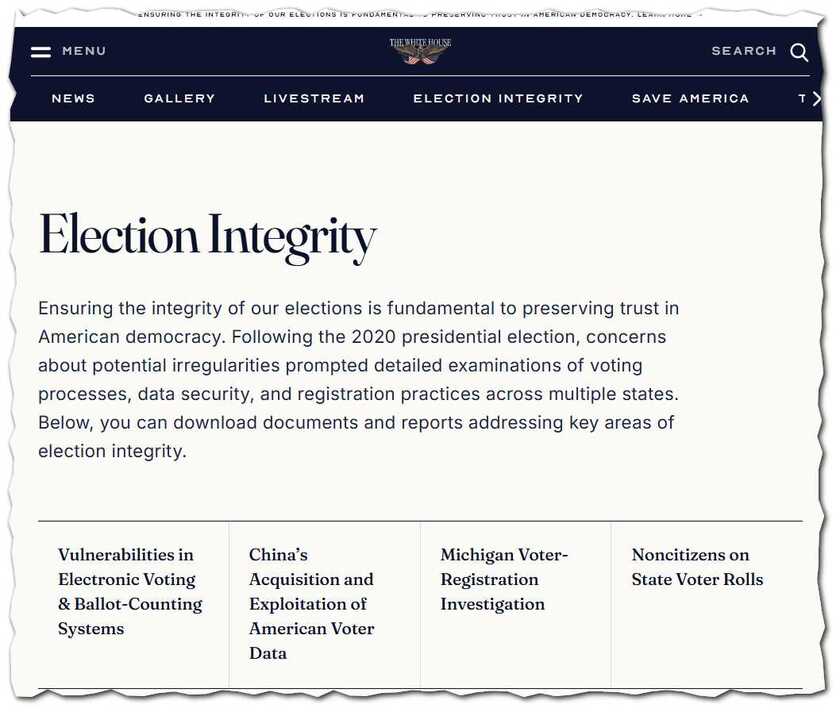
The White House has released a collection of previously classified or previously nonpublic government records concerning election security. The official landing page organizes the material into a presidential address and four principal categories: vulnerabilities in electronic voting and ballot-counting systems; China’s acquisition and exploitation of American voter data; the Michigan voter-registration investigation; and noncitizens appearing on state voter rolls.[1]
The White House characterizes the records as evidence of extensive cybersecurity vulnerabilities, foreign acquisition of voter information, insufficient handling of suspected registration fraud, and deficiencies in citizenship verification.[2] The released materials reportedly include intelligence assessments, FBI investigative records, CIA memoranda, DHS analyses, CISA evaluations, interagency communications, technical reviews, witness interviews, and prosecutorial memoranda. A contemporaneous reviewer who downloaded the archives reported approximately 58 documents totaling about 269 pages.[3]
The most supportable overall conclusion is that American election infrastructure faces genuine cybersecurity, counterintelligence, data-security, identity-verification, and administrative risks. The document collections appear to demonstrate that federal agencies investigated or assessed those risks over several years.[4] That is materially different, however, from proving that a vulnerability was successfully exploited, that United States vote totals were electronically changed, that every voter-record match represents an ineligible registrant, or that every investigative allegation constitutes a prosecutable crime.
The White House itself subsequently clarified that the President’s address was not presented as a claim concerning the outcome of a past American election. Rather, the administration says the address was intended to demonstrate foreign capabilities, continuing vulnerabilities, and alleged failures to communicate intelligence.[5]
From an originalist and federalist perspective, election reform must respect the Constitution’s allocation of powers. State legislatures possess the initial authority to regulate congressional election procedures, while Congress may alter those regulations by law. State legislatures also determine the manner of appointing presidential electors.[6] The President may enforce valid federal statutes and supervise executive agencies, but the executive power does not independently confer a general authority to write national election law.
The strongest policy response would therefore combine state-administered election security, congressional legislation where national standards are constitutionally authorized, executive enforcement of existing law, independent technical testing, voter-verifiable paper records, reliable audits, validated citizenship-data matching, notice and correction procedures, and prosecution where admissible evidence establishes an offense.
I. Purpose and Structure of the White House Release
The White House states that the purpose of the initiative is to preserve public trust by making available documents examining voting systems, registration practices, cybersecurity, foreign influence, and alleged irregularities following the 2020 election. The materials reportedly span from January 2020 through June 2026.[7]
The release functions in three ways:
As a declassification and transparency initiative
As an argument for additional election-security measures
As support for the administration’s request that Congress enact broader election legislation[8]
Official publication establishes that the Executive Branch released or endorsed the materials. It does not, by itself, establish the accuracy of every underlying allegation. Intelligence reports may contain raw reporting, differing confidence levels, source limitations, dissenting views, or preliminary assessments. Investigative files may document allegations that never resulted in charges or convictions.[9]
II. Category One
Vulnerabilities in Electronic Voting and Ballot-Counting Systems
A. White House position
The White House states that intelligence assessments have long recognized that Russia, China, Iran, North Korea, non-state groups, and other actors possess capabilities that could threaten portions of American election infrastructure. It particularly identifies centralized voter-registration databases, electronic pollbooks, election websites, election-management systems, and related repositories as attractive targets.[10]
The administration also refers to intelligence concerning alleged Venezuelan methods for digitally manipulating that country’s election results. The White House argues that the existence of such capabilities abroad demonstrates the need to prevent similar methods from being used against American systems.[14]
B. Reported contents of the archive
The first archive reportedly contains:[11]
Intelligence Community assessments
CISA technical evaluations
Election-system security reports
Interagency communications
Reviews of election-management systems
Assessments of voter-registration databases
Electronic-pollbook security information
Authentication and access-control findings
Network-segmentation concerns
Remote-access risks
Assessments of foreign cyber capabilities
A technical reviewer described the material as showing that federal agencies treated election systems as critical infrastructure requiring continuing security attention.[11]
C. What the category reasonably establishes
The collection supports several limited but significant propositions:[12]
Electronic election systems are not inherently immune from attack. Registration databases and supporting networks may be especially vulnerable because they are centralized, remotely administered, and dependent on identity, access, software, and configuration controls.
Foreign adversaries have both incentives and capabilities to probe election-related infrastructure.
Federal agencies were aware of vulnerabilities and produced internal assessments concerning them.
D. What the category does not establish without further evidence
A documented vulnerability does not prove that it was exploited.
Foreign capability does not prove operational access to a particular voting system.
An account of manipulation in Venezuela does not, standing alone, establish that the same method was used in the United States.[14]
Proof that a system could be compromised is not equivalent to proof that an American election outcome was changed. The administration’s own later statement says that the President was emphasizing risk and capability rather than claiming that the newly released records proved a past United States result had been altered.[13]
E. Recommended response
States should maintain voter-verifiable paper records, conduct statistically meaningful post-election audits, strictly limit remote access, segment election networks, require multifactor authentication, preserve system logs, test recovery procedures, and establish clear patch-management and incident-response requirements.
Independent examination should focus on whether identified vulnerabilities were remedied and whether forensic evidence shows actual exploitation.
III. Category Two
China’s Acquisition and Exploitation of American Voter Data
A. White House position
The White House alleges that entities connected to the People’s Republic of China acquired information associated with approximately 220 million American voter records. It says the material included names, addresses, telephone numbers, party information, and other data useful for targeting individuals or constructing detailed population datasets.[15]
The administration further asserts that intelligence agencies became aware during 2020 that information involving voters in at least 18 states had been purchased, stolen, hacked, or otherwise obtained, and that important information was not properly communicated to the President or Congress.[15]
B. Reported contents of the archive
The second and largest archive reportedly includes:[16]
FBI reporting
CIA memoranda
National Intelligence Council products
Counterintelligence assessments
Election-related intelligence reporting
President’s Daily Brief coordination communications
Analyses involving multiple states
Internal discussions about intelligence dissemination
Assessments of Chinese data-collection and exploitation activities
The records reportedly address not only whether information was obtained, but also how it could support foreign influence, intelligence targeting, social engineering, identity fraud, or other malicious activity.[16]
C. National-security significance
Large collections of voter information can be important even when portions of the information are publicly available. The security concern depends on aggregation, accuracy, the addition of nonpublic identifiers, integration with commercial or breached datasets, and the intended use.[17]
A foreign intelligence service could use such information to:
Identify politically influential or vulnerable individuals
Develop targeted influence operations
Improve phishing or impersonation campaigns
Correlate political, financial, employment, or family information
Identify government personnel or communities of intelligence interest[17]
D. Intelligence-suppression allegation
The White House points to internal communications that it characterizes as evidence that some officials intentionally kept election-related intelligence out of presidential briefing products. It has directed relevant intelligence and law-enforcement agencies to investigate how information was handled.[18]
A proper evaluation should distinguish among:
Ordinary intelligence editing
Disagreement over source credibility
Decisions about analytical confidence
Improper political manipulation
Intentional concealment
Potential criminal conduct
Proving an unlawful coverup would require evidence of intent, responsibility, a legal duty to disclose, and an identifiable act of concealment. A disputed editorial or analytical judgment is not automatically criminal.
E. Recommended response
The government should publish a classified and unclassified damage assessment, identify the affected systems and states, determine whether the data was public or restricted, review data-broker access, notify affected jurisdictions, and provide verifiable timelines.
Congressional intelligence committees should examine whether political considerations improperly affected intelligence collection, analysis, or dissemination.
IV. Category Three
Michigan Voter-Registration Investigation
A. White House position
The White House describes an investigation originating in Muskegon, Michigan, involving a voter-registration and get-out-the-vote operation. It states that Michigan authorities contacted the FBI after discovering suspicious applications and related materials.[19]
According to the White House summary, investigative records contain allegations that some canvassers signed forms using other people’s names, submitted registrations involving nonexistent persons, and received compensation or gift cards connected to application volume. The administration alleges that the investigation was not handled with sufficient urgency.[19]
B. Reported contents of the archive
The archive reportedly includes:[20]
FBI investigative timelines
Witness and canvasser interviews
Requests for forensic document examination
Requests for laboratory assistance
Investigative summaries
Prosecutorial-review memoranda
Records concerning allegedly false registrations
Compensation and gift-card information
Documentation of investigative activity continuing into 2024
A reviewer of the archive concluded that the records establish the existence of a substantial federal investigation involving interviews, document analysis, and interagency work.[20]
C. Evidentiary assessment
The existence of an FBI investigation establishes that the allegations were considered sufficiently serious to examine. It does not establish that every allegation was verified.[21]
Witness statements may constitute evidence, but their reliability depends on corroboration, firsthand knowledge, consistency, motive, and admissibility.
A false registration application is not necessarily proof that a ballot was issued, returned, counted, or affected an election result.
A prosecutorial decision not to charge may reflect inadequate evidence, legal defects, witness problems, resource priorities, or improper delay. The released materials should be examined to determine which explanation is supported. One released record, as reported by the Associated Press, stated that the case was closed because investigative leads had been exhausted without identification of a criminal violation or priority national-security threat.[21]
D. Recommended response
The Justice Department and Michigan authorities should provide a clear public disposition, subject to grand-jury and privacy restrictions. That disposition should identify:
The number of questioned applications
The number determined to be false
Whether any false records became active registrations
Whether ballots were requested or cast
Whether organizers directed unlawful conduct
Why charges were or were not pursued
Confirmed offenses should be prosecuted without regard to party affiliation. Unproven allegations should not be presented as convictions.
V. Category Four
Noncitizens on State Voter Rolls
A. White House position
The White House landing page states that a DHS review identified approximately 278,000 noncitizens registered for federal elections and argues that the actual total could be higher because some states did not provide requested data.[22]
Federal law generally prohibits noncitizens from voting in elections involving federal offices, subject to limited statutory exceptions.[23]
B. Reported contents of the archive
The archive reportedly contains:[24]
DHS voter-record analyses
Comparisons between state and federal data
Apparent noncitizen matches
Methodology summaries
Statistical reports
Plans for additional state reviews
Materials concerning the federal SAVE verification system
The supporting documents reportedly describe continuing verification, indicating that at least some records were preliminary rather than final adjudications of citizenship or voting eligibility.[24]
C. Numerical and methodological issue
The administration’s public descriptions require clarification.[25]
One official White House release described the approximately 278,000 records as having been found across four states that cooperated. The White House landing page, however, states that Democratic-led states refused to provide their voter files.
The Associated Press reported that the DHS materials described more than a quarter-million claimed records in California, Pennsylvania, New Jersey, and Nevada based on public records, plus approximately 28,000 claimed matches in 25 states through the SAVE system. The AP also reported that the figures had not been verified and that the public-record sources could contain incomplete or erroneous information.[25]
That distinction matters because the reliability of a match depends heavily on the data used. A comparison using complete identifiers and current immigration records is substantially stronger than one relying on commercial databases, partial names, incomplete birthdates, or public voter files.
D. Registration, voting, and database matching are different questions
A person appearing as a possible noncitizen match is not necessarily an ineligible voter.[26] Possible explanations include:
The individual became a naturalized citizen after an older record was created
Different people have similar names or dates of birth
An immigration or motor-vehicle record is outdated
The voter record contains incomplete identifying information
A person registered accidentally but never voted
The data-matching system produced a false positive
Registration also does not prove that a ballot was cast. A valid analysis must separately determine citizenship at the relevant time, registration status, voting history, and intent.[26]
E. Recommended response
DHS should publicly disclose its methodology, matching criteria, error rate, confidence categories, sources, and state-by-state totals.
States should individually verify flagged records before cancellation or referral. Every affected voter should receive notice, an opportunity to provide citizenship documentation, and a meaningful correction procedure.
Confirmed unlawful registration or voting should be referred for prosecution. Removal should not be based solely on unverified commercial or probabilistic data.
VI. Constitutional and Federalism Analysis
A. State authority
The Constitution assigns state legislatures the initial responsibility for prescribing the times, places, and manner of congressional elections. Article II separately directs each state to appoint presidential electors in the manner its legislature determines. These provisions reflect the Founders’ state-centered structure of election administration.[27]
B. Congressional authority
The Elections Clause expressly permits Congress to make or alter state regulations governing congressional elections. National rules concerning federal-election procedures therefore rest most securely on legislation enacted by Congress rather than unilateral executive direction.[28]
Congress may also legislate under the enforcement provisions of the Reconstruction and voting-rights amendments, subject to the limits imposed by constitutional text and federalism.
C. Executive authority
The President has authority to enforce federal criminal and election statutes, direct executive agencies, protect federal systems, conduct counterintelligence operations, and request information authorized by law.
The President does not possess a general constitutional power to replace state election codes or legislate new nationwide requirements without congressional authorization. Executive orders must remain within statutory and constitutional authority.
The administration’s March 2026 order relies on the Help America Vote Act, the National Voter Registration Act, Article II enforcement authority, and the Guarantee Clause. It directs federal citizenship-list creation, investigative priorities, and proposed postal rules for election mail.[29]
D. Tenth Amendment and anti-commandeering concerns
The federal government may preempt state law when acting under an enumerated power, but it generally may not compel state officers to administer a federal regulatory program merely through executive command. Modern federalism doctrine recognizes limits on federal attempts to commandeer state governments.[30]
Funding conditions, information demands, and federal database requirements should therefore have clear statutory authority, provide fair notice, and avoid coercive intrusion into state sovereignty.
E. Guarantee Clause
The administration invokes Article IV’s guarantee of a republican form of government. The clause establishes an important constitutional obligation, but its text does not clearly grant the President unlimited authority to prescribe election procedures. It should be interpreted alongside the specific allocations of authority in Articles I and II.[31]
VII. Consolidated Findings
Finding 1: Election cybersecurity is a legitimate national-security concern
The materials support continued hardening, auditing, testing, and monitoring of election infrastructure.[32]
Finding 2: Vulnerability must not be confused with successful exploitation
A responsible report should identify the precise system affected, the access obtained, the forensic evidence, the remediation status, and any demonstrated effect.[33]
Finding 3: Foreign acquisition of voter information warrants a formal damage assessment
The 220-million-record allegation is serious enough to require transparent technical and counterintelligence examination.[34]
Finding 4: The Michigan allegations merit a definitive legal disposition
The released records reportedly establish a genuine investigation but do not, without adjudication, establish guilt or electoral effect.[35]
Finding 5: The 278,000 figure requires methodological validation
The administration should reconcile its differing descriptions, separate confirmed cases from preliminary matches, and distinguish registration from actual voting.[36]
Finding 6: Official status is not equivalent to conclusive proof
The records are important government materials. Their individual evidentiary value nevertheless depends on source reliability, authentication, corroboration, confidence levels, and legal findings.[37]
Finding 7: Lasting reform should follow constitutional channels
States should administer elections, Congress should legislate national federal-election standards where authorized, and the Executive should enforce enacted law rather than substitute administrative directives for legislation.[38]
VIII. Recommended Action Plan
For Congress
Conduct bipartisan oversight hearings, require a complete archive inventory, obtain testimony from the document authors, examine intelligence-dissemination decisions, and legislate clear federal-election standards within Article I authority.[39]
For federal agencies
Release document manifests, dates, originating offices, declassification authority, redaction explanations, and cryptographic file hashes. Separate raw intelligence from final assessments and identify confidence levels.[40]
For states
Use voter-verifiable records, risk-limiting audits, strong access controls, documented chain-of-custody procedures, accurate voter-list maintenance, and individualized citizenship verification.[41]
For investigators
Distinguish administrative error, negligent conduct, intentional fraud, foreign influence, cyber intrusion, and successful vote manipulation. Each requires different evidence and legal analysis.[42]
For the public record
Publish confirmed findings, unresolved questions, contrary intelligence views, remedial actions, and final case dispositions. Transparency should include evidence that weakens as well as supports the administration’s position.[43]
Conclusion
The White House release presents election integrity as a combined cybersecurity, counterintelligence, law-enforcement, voter-eligibility, and constitutional-governance issue.[44] Its strongest contribution is the disclosure that federal agencies repeatedly examined vulnerabilities and potential misconduct that deserve public scrutiny.[45]
The release is less conclusive as proof of altered United States vote totals, verified mass noncitizen voting, criminal responsibility in Michigan, or unlawful intelligence suppression. Those conclusions require validated data, authenticated forensic evidence, complete investigative records, and appropriate legal proceedings.[46]
The constitutional answer is neither exclusive federal control nor indifference to national threats. It is the system established by the Founders: state responsibility, congressional authority exercised through legislation, faithful executive enforcement, independent adjudication, and transparent evidence sufficient to preserve both election security and lawful voting rights.[47]
Source Legend by Point Number
“Election Integrity” — The White House: 1, 2, 4, 7, 8, 10, 14, 15, 19, 22, 25, 34, 44, 46. (The White House)
“SETTING THE RECORD STRAIGHT: President Trump Declassifies Intel on Foreign Election Interference and Deep State Coverup” — The White House: 2, 5, 8, 13, 18, 25, 46. (The White House)
“Hacking US Elections: The First Tranche of Declassified Election Integrity Documents” — Cyber Defense Magazine: 3, 4, 9, 11, 12, 16, 17, 20, 21, 24, 26, 32, 33, 34, 35, 36, 37, 40, 41, 42, 43, 45, 46. (Cyber Defense Magazine)
“Trump Says These Documents Prove His False Claims of Election Fraud. Here’s What They Really Say” — Associated Press: 21, 25, 26, 35, 36, 41, 46. (AP News)
“18 U.S.C. § 611: Voting by Aliens” — United States Code: 23. (U.S. Code Online)
“Article I, Section 4 — Elections Clause” — Constitution Annotated: 6, 27, 28, 38, 39, 47. (Congress.gov)
“Article II, Section 1, Clause 2 — Electors” — Constitution Annotated: 6, 27, 38, 47. (Congress.gov)
“Ensuring Citizenship Verification and Integrity in Federal Elections” — Executive Order 14399, The White House: 29, 38, 47. (The White House)
“Modern Tenth Amendment Jurisprudence Generally” — Constitution Annotated: 30, 38, 47. (Congress.gov)
“Article IV, Section 4 — Republican Form of Government” — Constitution Annotated: 31, 47. (Congress.gov)