the Conservative TAKE
Politics • Culture • News
Why the Left Fears 2028: Their Only Hope is to Divide MAGA Now
December 31, 2024
post photo preview

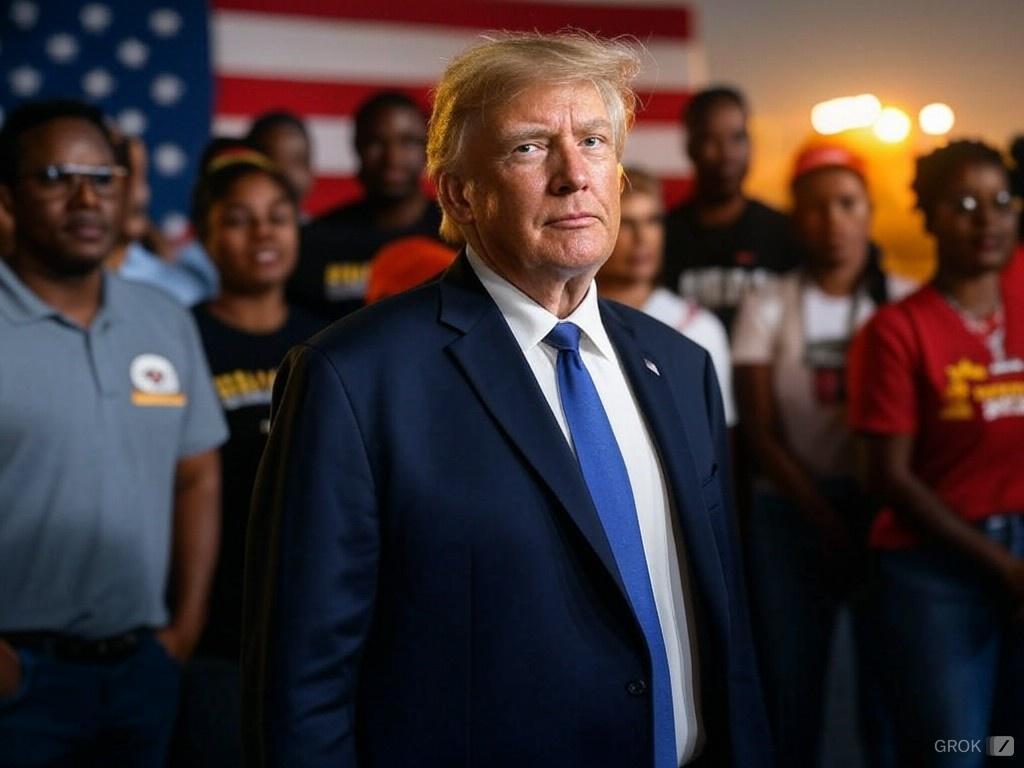
As an organization that proudly supported Donald Trump, we celebrate the historic mandate he received to "fix it", to restore America’s strength, sovereignty, and unity. The 2024 election was a resounding GOP landslide, with every demographic moving decisively toward Trump: Hispanics, working-class voters, Black Americans, women, Asians, and more. This election showed that Trump is not just a leader for one party or one group; he promised to be a president for allAmericans.

We must acknowledge the ongoing attempts by the liberal mainstream media to divide the MAGA movement and undermine Trump’s agenda. Over the past eight years, the media has repeatedly proven itself willing to distort facts and promote false narratives. From the Russia collusion hoax to the suppression of the Hunter Biden laptop story, from twisting Trump’s “very fine people” comments to peddling the Steele dossier, the media has lied consistently and shamelessly.

Now, with Trump returning to office, these tactics are being renewed in force. The media is already driving wedges by exploiting controversies like H1B visas, the “Elon is President” distraction, mass deportation misinformation, the Trump-Johnson Speakership narrative, and the continuing resolution debates. The goal of these stories is not to inform but to inflame and to pit MAGA supporters against one another, weaken Trump’s coalition, and stall the America First agenda.

The Stakes: Trump’s Success is America’s Success

The reality is clear: as long as Donald Trump is successful, the left cannot win. The data from Pennsylvania underscores this truth. GOP voter registrations have surged, shifting the political landscape of a historically key state. This movement demonstrates the broad appeal and staying power of Trump’s message. The left knows that Trump’s success threatens their political future, not just in 2024 but for years to come.

Consider the stakes for the future of the Republican Party and the conservative movement. The easiest path for a 2028 JD Vance victory (or any future MAGA-aligned candidate) is for Trump to deliver on his promises. If Trump fails in his mandate to fix the nation, it will create an opening for the left to exploit and unravel the progress made under his leadership. This is precisely why the media and their allies are working so hard to divide us now, even before Trump officially begins his second term.

The left’s ultimate goal is to see Trump fail because they know that his success solidifies a durable political realignment: a coalition of working-class voters, minorities, and everyday Americans who reject the globalist, anti-American agenda of the elites. As long as Trump fulfills his promises, the left’s vision of political dominance is unattainable.

Unity is Key to MAGA’s Success

We must remember why we elected Donald Trump. He brings a unique perspective, informed by intelligence briefings and real-time knowledge of global and domestic challenges. While we may not always understand or agree with every decision, we trust that his leadership is guided by a commitment to the long-term success of the country.

MAGA is not about any one person; it is about putting America First for all people, today and for future generations. Unity is our greatest strength, and division is the left’s only hope for victory. Reject their lies. Reject their tactics. Stay focused on the mission.

As we move forward, let us remain united behind President Trump and the agenda we voted for. His success is America’s success, and by standing firm together, we will secure a brighter future for all Americans. Remember, the media’s goal is division, but our goal is greatness. United we stand, divided we fall. It’s time to move forward with confidence, determination, and trust in the leader we chose to guide this nation to renewed greatness.


community logo
Join the the Conservative TAKE Community
To read more articles like this, sign up and join my community today
0
What else you may like…
Videos
Posts
Articles
Odds of Love: A Probability Study Proving Jasmine Crockett’s Race Baiting Ignores the Real Challenges of Finding a Conservative Black Match

EXECUTIVE SUMMARY

Representative Jasmine Crockett’s recent criticism of Representative Byron Donalds for marrying a white woman highlights a regressive mindset steeped in ignorance and racial bias, casting doubt on her ability to engage with the diverse realities of American life.

https://x.com/EricLDaugh/status/1906302926571618409

By implying that Donalds has been “whitewashed” through his interracial marriage, Crockett clings to outdated stereotypes that dictate racial loyalty over personal agency, exposing her own hypocrisy in advocating for equality while policing others’ private choices. This narrow perspective stands in stark contrast to the evolving dynamics of relationships across racial lines, as evidenced by a probabilistic analysis of partner selection among conservative Black individuals. To illustrate the complexity of such dynamics, consider the following study estimating the likelihood of a conservative Black man finding and marrying a conservative Black woman who aligns with his values—a scenario Crockett might deem more “acceptable,” yet one fraught with its own...

00:00:46
00:01:20
Biblical Citizenship in Modern America Commentary Ep14 - Understanding the Times 3

00:00 Introduction
02:03 Week 13 review
04:56 Our Current Education System
05:59 Six Verbs for Advancing Truth in the Country
09:08 What Our Elected Officials Don't Know About America
10:44 The Foundation of Law
12:12 Who Were the Signers of the Declaration of Independence?
13:52 Benjamin Rush
15:44 What is Patriotism?
18:34 Summary of Workbook

00:25:36
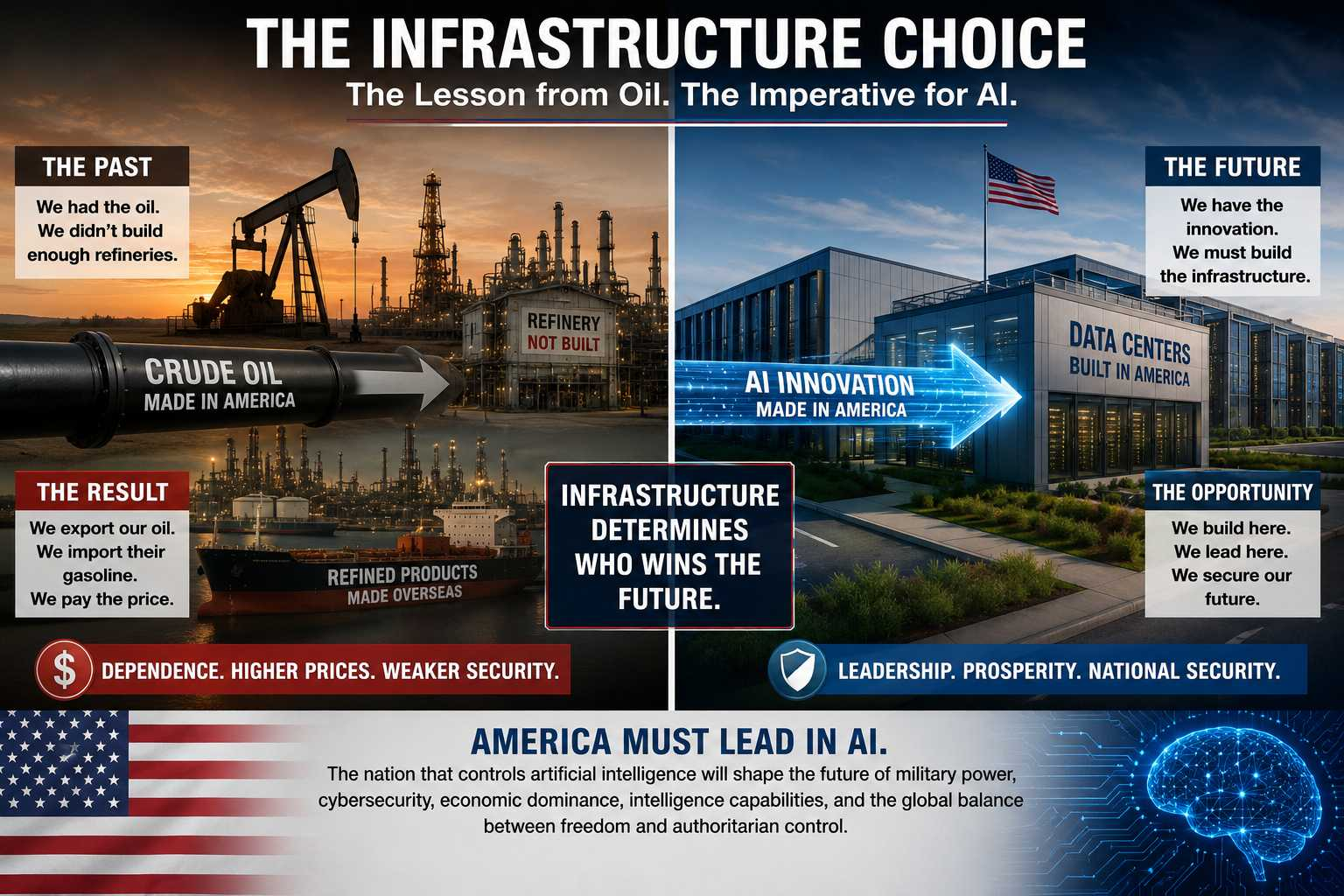
AI Infrastructure Is the New Oil Refinery

America must lead in artificial intelligence because the nation that controls AI will shape the future of military power, cybersecurity, economic strength, intelligence capabilities, and the balance between free societies and authoritarian regimes.

That reality makes today's debate over AI infrastructure far more important than many people realize.

To understand why, consider a lesson from America's energy history.

The Energy Lesson Few People Learned

For decades, Americans have complained about gasoline prices and dependence on foreign energy, particularly from the Middle East. Yet one of the great ironies of modern energy policy is that producing oil and processing oil are two entirely different things.

A nation can sit on enormous natural resources and still find itself vulnerable if it lacks the infrastructure needed to transform those resources into finished products.

The United States became one of the world's largest oil producers, but expanding refining capacity proved far more difficult. Regulatory hurdles, permitting battles, litigation, and ...

post photo preview

Iran is unraveling right before our very eyes, and the regime knows it. The panic merchants were dead wrong again: there is no forever war, no quagmire, and zero mass U.S. casualties. Three American carrier strike groups have now fully encircled the Islamic Republic: the USS Gerald R. Ford slicing through the Suez into the Red Sea, the USS Abraham Lincoln sealing the eastern flank from the Arabian Sea, and the USS George H.W. Bush closing the trap from the south after its 6,000-mile voyage around Africa. This is the first time in over two decades the U.S. has deployed three carriers against a single target, creating a lethal naval cage with zero escape. Trump’s deliberate slow-rolling tactics have proven far smarter than any rush to extended bombing; the blockade is already in full effect, strangling Iran’s economy to the tune of half a billion dollars every single day. They’re boxed in with nowhere to go, and Trump is resetting the map on America’s terms.
Kharg Island (Iran’s...

Public Statement on James Comey and Claims of Unawareness Regarding the Meaning of “8647”: Legal Accountability and Knowledge of the Law

Recent public commentary surrounding statements attributed to James Comey has raised broader questions about legal responsibility and the role of intent or awareness in evaluating potentially unlawful conduct.
As a general principle, long recognized in U.S. jurisprudence, ignorance or misunderstanding of the law does not excuse conduct that would otherwise constitute a violation. Individuals (particularly those who have held positions of public trust) are expected to exercise reasonable judgment and awareness regarding how their actions or statements may be interpreted under applicable laws and standards.
At the same time, any determination of legal liability depends on a full assessment of facts, context, and applicable statutes, including whether the relevant legal thresholds (such as intent, recklessness, or negligence) are met.
Public discourse should remain grounded in these principles, while allowing appropriate legal processes to evaluate the matter based on evidence rather than...

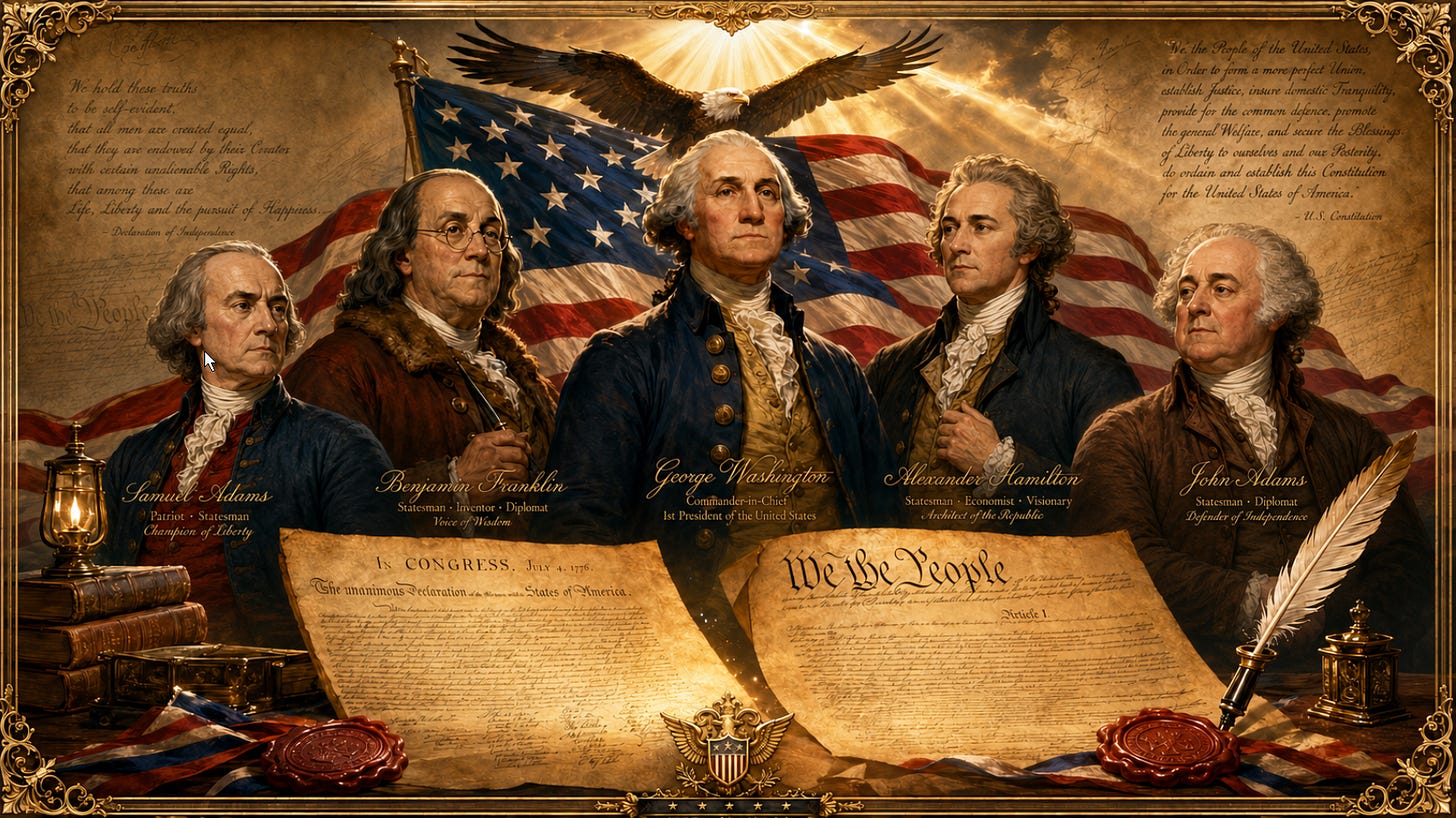
250 Reasons Why America is the Greatest Country to EVER Exist

Happy Independence Day, and a historic happy 250th birthday to the United States of America!

Today, July 4, 2026, we celebrate a nation built on the foundational truth that our fundamental rights are granted by God, not by government. Throughout our history, the American story has been carried forward by leaders and patriots who understood that liberty is always worth defending from the Founding Fathers and Abraham Lincoln to Frederick Douglass, Booker T. Washington, Dwight D. Eisenhower, Douglas MacArthur, George S. Patton, Chester W. Nimitz, Ronald Reagan, President Donald J. Trump, and Charlie Kirk.

While America is not perfect, she is profoundly worth loving, protecting, and preserving for the next generation. God has uniquely used this nation to shatter tyranny, champion global freedom, and carry the Gospel to every corner of the earth. Today, we offer our gratitude to God for this country, honor the heroes who built and defended her, and firmly recommit ourselves to faith, family, and freedom.

Below is an exhaustive list of 250 distinct reasons (though we easily could have listed thousands more) why the United States stands as the greatest nation to ever exist. To show the full scope of the American experiment, these reasons are organized across five critical dimensions, highlighting the tangible impacts, institutional brilliance, and lasting consequences of American liberty, power, prosperity, innovation, and global reach.


250 Strict Constructionist Reasons the United States Is the Greatest Nation to Ever Exist

I. Founding Principles, Natural Rights, and the American Creed

  1. The United States is the greatest nation because it made the truth of God-given, unalienable individual rights the central moral claim of its founding.

  2. The Declaration of Independence teaches that rights come from the Creator, not from kings, legislatures, courts, presidents, or bureaucracies.

  3. America was founded on the principle that government exists to secure pre-existing rights, not to create or ration them.

  4. The Founders grounded political legitimacy in the consent of the governed.

  5. The United States rejected monarchy and hereditary rule in favor of republican self-government.

  6. America’s founding creed placed the individual person above the state.

  7. The American Revolution was not merely a rebellion against taxes; it was a defense of lawful liberty against arbitrary power.

  8. The Declaration supplied the moral foundation for the Constitution’s legal structure.

  9. The Constitution translated the principles of liberty into a durable system of government.

  10. America created a written Constitution so that government would be bound by fixed law.

  11. The Constitution is supreme over ordinary politics, temporary majorities, and public officials.

  12. The American system assumes that power must be restrained because human nature is imperfect.

  13. The Founders understood that liberty requires virtue, self-discipline, religion, family, and civic duty.

  14. America’s founding rejected the idea that citizens are subjects of government.

  15. The American people are sovereign; public officials are agents with delegated authority.

  16. The Constitution protects liberty by limiting government first.

  17. The United States made ordered liberty, not lawless license, the goal of republican government.

  18. America’s founding principles are universal in moral truth but national in constitutional application.

  19. The American creed allows people from many backgrounds to become one people through allegiance to shared principles.

  20. The Founders did not create a perfect society, but they gave the nation principles capable of judging and correcting injustice.

  21. The United States became exceptional because its founding documents provide a standard above political convenience.

  22. America’s greatness rests on the proposition that no ruler is above the law.

  23. America’s constitutional order made freedom practical by giving it institutional form.

  24. The United States proved that liberty could be secured across a vast republic.

  25. America’s founding remains unmatched because it joined natural rights, popular sovereignty, written law, and limited government in one enduring national order.

II. Constitutional Structure and Limited Government

  1. The Constitution created a federal government of limited and enumerated powers.

  2. The national government may exercise only those powers delegated to it by the Constitution.

  3. The Tenth Amendment confirms that undelegated powers are reserved to the states or to the people.

  4. Federalism protects liberty by dividing authority between national and state governments.

  5. The states are constitutional actors, not mere administrative districts of Washington, D.C.

  6. Local self-government allows communities to govern many matters close to home.

  7. The Constitution separates legislative, executive, and judicial power to prevent tyranny.

  8. Congress makes law; the President executes law; courts decide cases and controversies under law.

  9. The separation of powers prevents one branch from becoming master of the others.

  10. The Constitution’s checks and balances force deliberation before national power is exercised.

  11. Bicameralism makes federal law harder to enact, which protects liberty from rash legislation.

  12. The House of Representatives gives the people direct representation in federal lawmaking.

  13. The Senate preserves the federal character of the Union.

  14. The Electoral College reflects the Constitution’s federal design rather than simple national majoritarianism.

  15. The President’s veto protects against unconstitutional, unwise, or hasty legislation.

  16. Congressional control of appropriations keeps the public purse under elected representatives.

  17. Congress, not the President alone, has the constitutional authority to declare war.

  18. The Commander in Chief Clause allows energetic military leadership within constitutional bounds.

  19. Impeachment provides a constitutional remedy for serious abuse of public trust.

  20. The Constitution requires officeholders to swear allegiance to the Constitution, not to a ruler or party.

  21. The amendment process allows lawful change without revolution.

  22. The difficulty of amendment protects the Constitution from temporary passions.

  23. Judicial review is legitimate when courts enforce the Constitution’s text and original meaning.

  24. Judicial power becomes dangerous when judges substitute personal policy views for constitutional law.

  25. The Constitution’s structure is one of America’s greatest achievements because it restrains power while allowing effective self-government.

III. The Bill of Rights, Rule of Law, and Civil Liberty

  1. The Bill of Rights recognizes that some liberties are beyond the reach of ordinary government power.

  2. The First Amendment protects speech because free citizens must be able to debate truth and criticize government.

  3. Freedom of the press allows public scrutiny of officials.

  4. Freedom of religion protects conscience from state coercion.

  5. The Free Exercise Clause protects the right to live according to sincere religious conviction.

  6. The Establishment Clause prevents a national church while preserving public religious liberty.

  7. The right to assemble protects peaceful civic action.

  8. The right to petition allows citizens to seek redress from government without violence.

  9. The Second Amendment protects the right of the people to keep and bear arms.

  10. The right to bear arms reflects both personal defense and the Founders’ distrust of concentrated coercive power.

  11. The Third Amendment reflects America’s rejection of military domination over civilian life.

  12. The Fourth Amendment protects the people against unreasonable searches and seizures.

  13. The warrant requirement protects the home from arbitrary intrusion.

  14. The Fifth Amendment protects life, liberty, and property through due process of law.

  15. The Takings Clause prevents government from seizing private property without just compensation.

  16. The privilege against self-incrimination restrains coercive prosecution.

  17. Protection against double jeopardy limits government’s power to repeatedly prosecute.

  18. The Sixth Amendment protects the accused through counsel, confrontation, public trial, and impartial jury.

  19. Trial by jury places citizens between the individual and the state.

  20. The Seventh Amendment preserves the civil jury as a guardian of private rights.

  21. The Eighth Amendment limits excessive fines and cruel or unusual punishments.

  22. The Ninth Amendment warns that enumerating certain rights does not deny others retained by the people.

  23. The Tenth Amendment preserves the Constitution’s limited-government structure.

  24. The rule of law protects citizens from arbitrary rule by officials.

  25. America is great because its constitutional liberties are not merely policy preferences; they are legal barriers against government power.

IV. Ending Slavery, Equal Citizenship, and Constitutional Self-Correction

  1. America’s founding principles created the moral standard by which slavery was ultimately condemned.

  2. The contradiction between slavery and the Declaration’s principle of human equality became impossible to ignore.

  3. The abolitionist movement drew strength from America’s founding claim that all men are created equal.

  4. The Civil War tested whether a nation conceived in liberty could endure.

  5. The Union victory preserved the constitutional republic.

  6. The Thirteenth Amendment abolished slavery throughout the United States.

  7. The Fourteenth Amendment placed national citizenship, due process, and equal protection into the constitutional text.

  8. The Fifteenth Amendment forbade racial discrimination in voting rights.

  9. The Reconstruction Amendments corrected grave injustice through constitutional amendment, not judicial invention.

  10. America’s capacity for lawful self-correction is one of its greatest strengths.

  11. The Constitution gave later generations tools to bring the country closer to its founding promises.

  12. Equal protection under law reflects the equal moral worth of persons before God and law.

  13. The abolition of slavery was one of the greatest moral achievements in American history.

  14. The United States paid an immense cost in blood to preserve the Union and end slavery.

  15. The postwar constitutional settlement rejected the idea that states may deny basic citizenship rights.

  16. America’s civil rights progress is strongest when rooted in the Constitution’s text and amendments.

  17. The rule of law allowed the nation to confront injustice without abandoning constitutional government.

  18. The American promise of equality is equality of rights, not forced equality of outcomes.

  19. The Constitution protects persons as individuals, not merely as members of groups.

  20. America’s struggle against slavery shows that founding principles can outlive and defeat founding compromises.

  21. The peaceful expansion of voting rights through amendment demonstrates lawful constitutional development.

  22. The civil jury, due process, and equal protection became tools for vindicating individual rights.

  23. America’s best reformers appealed to the Declaration and Constitution rather than rejecting them.

  24. The United States is great not because it has never sinned, but because its founding principles provide the means to repent, correct, and improve.

  25. The end of slavery proves that America’s founding promise was not empty rhetoric but a standard powerful enough to transform the nation.

V. Economic Liberty, Property Rights, and Entrepreneurial Power

  1. America became an economic superpower because it protected property, contract, enterprise, and voluntary exchange.

  2. Secure property rights allowed ordinary citizens to build independence.

  3. The protection of private property limits dependence on government favor.

  4. The Constitution’s Takings Clause protects ownership from uncompensated seizure.

  5. The Contract Clause reflects the importance of stable legal obligations.

  6. Patent and copyright protections encouraged invention and creative labor.

  7. A vast internal market allowed Americans to trade across state lines under one constitutional Union.

  8. The Constitution helped prevent states from waging economic warfare against one another.

  9. Free enterprise rewarded innovation, risk, work, and discipline.

  10. America’s economy grew because citizens could start businesses without hereditary permission.

  11. The American system encouraged the self-made citizen.

  12. Free labor became a defining principle of American prosperity.

  13. American farms helped feed the nation and much of the world.

  14. American industry turned resources, labor, and invention into unmatched productive power.

  15. American railroads, factories, ports, and markets connected a continental republic.

  16. American capitalism created wealth through production and exchange rather than conquest or caste.

  17. Competition improved quality and lowered costs for ordinary people.

  18. Prices and profit-and-loss signals coordinated human activity better than central planning.

  19. The American system allowed failure, recovery, and reinvention.

  20. Small businesses became engines of local independence and community strength.

  21. Capital markets helped finance innovation, expansion, and enterprise.

  22. America attracted immigrants because it offered opportunity under law.

  23. Immigrant families helped build American agriculture, industry, science, culture, and commerce.

  24. Private philanthropy flourished because wealth could be created and given voluntarily.

  25. America’s economic greatness rests on liberty under law, not state control of human ambition.

VI. Science, Medicine, Technology, and Innovation

  1. America’s constitutional liberty created room for scientific discovery and technological creativity.

  2. American inventors helped bring practical electric light and power to modern civilization.

  3. American innovation transformed communication through the telegraph, telephone, radio, television, and digital networks.

  4. The Wright brothers launched the age of powered flight.

  5. Henry Ford’s assembly-line production helped make automobiles affordable to ordinary citizens.

  6. American industry made mass production a force for rising living standards.

  7. Bell Labs’ transistor helped make the modern electronics revolution possible.

  8. American semiconductor innovation helped create the digital age.

  9. American computing placed extraordinary power in the hands of ordinary people.

  10. The United States helped create and commercialize the modern internet.

  11. American software and hardware transformed business, education, communication, and research.

  12. GPS, developed through American defense and space capability, transformed navigation, logistics, agriculture, and daily life.

  13. American medical researchers contributed greatly to antibiotics, vaccines, surgery, imaging, and biotechnology.

  14. The polio vaccine stands among America’s most important gifts to humanity.

  15. American pharmaceutical and medical-device innovation has saved and improved countless lives.

  16. American hospitals, universities, laboratories, and private firms created a powerful research ecosystem.

  17. The Human Genome Project demonstrated America’s leadership in large-scale scientific cooperation.

  18. American biotechnology opened new paths for treating disease.

  19. American agricultural science increased yields and helped fight hunger.

  20. American engineering produced safer air travel, stronger infrastructure, and better communications.

  21. American energy innovation strengthened national prosperity and security.

  22. American computer science laid foundations for artificial intelligence, data systems, and modern automation.

  23. American invention succeeded because free people were allowed to test, build, compete, and profit.

  24. America’s scientific greatness reflects both private initiative and constitutionally authorized public support.

  25. The United States has improved human life through discovery on a scale few civilizations have approached.

VII. Space, Exploration, Infrastructure, and National Achievement

  1. America’s space program demonstrated the power of free citizens pursuing great national goals.

  2. The Apollo program achieved the first human landing on the Moon.

  3. The Moon landing showed the world that a constitutional republic could outcompete totalitarian central planning.

  4. NASA’s achievements inspired generations in science, engineering, aviation, and exploration.

  5. American astronauts became symbols of courage, discipline, and national purpose.

  6. The Space Shuttle program expanded human spaceflight and orbital operations.

  7. American satellites transformed weather forecasting, communications, defense, mapping, and navigation.

  8. The United States helped make space a domain of scientific discovery and practical benefit.

  9. American private enterprise later reduced the cost of reaching space through reusable rocket technology.

  10. America’s space achievements joined national defense, science, and imagination.

  11. The interstate highway system strengthened commerce, mobility, and national defense.

  12. American aviation connected the continent and the world.

  13. American ports, railroads, pipelines, and highways made the nation a logistical power.

  14. American engineering helped build dams, bridges, airports, and energy systems of continental scale.

  15. The United States became a nation capable of moving people, goods, information, and military power with unmatched speed.

  16. American infrastructure reflected both state, local, private, and federal contributions.

  17. The American spirit of exploration moved from frontier settlement to air, sea, space, and digital frontiers.

  18. America’s achievements in aviation and space were made possible by education, industry, science, and national confidence.

  19. American weather satellites and forecasting systems have saved lives around the world.

  20. American communications satellites made global broadcasting and connectivity possible.

  21. American mapping and navigation technologies improved farming, shipping, emergency response, and defense.

  22. American exploration reflects a culture that refuses stagnation.

  23. The United States repeatedly turned difficult frontiers into fields of discovery.

  24. America’s space and infrastructure achievements show what free people can build when united by purpose.

  25. The American record in exploration proves that liberty and greatness are not opposites but partners.

VIII. Military Power, National Defense, and the Fight Against Tyranny

  1. The Constitution gives the federal government a central duty: to provide for the common defense.

  2. America’s military power is legitimate when used to defend the nation, protect citizens, honor constitutional authority, and secure peace through strength.

  3. American service members swear an oath to the Constitution, not to a monarch or dictator.

  4. Civilian control of the military preserves republican government.

  5. Congress’s war powers require national deliberation before war.

  6. America’s entry into World War I helped tip the balance against imperial aggression in Europe.

  7. World War I showed America’s industrial and military capacity on the world stage.

  8. American sacrifice in World War I helped shape the modern era.

  9. In World War II, American industry became the arsenal of freedom.

  10. American soldiers, sailors, Marines, and airmen helped defeat Nazi Germany.

  11. American power helped defeat Imperial Japan and end the war in the Pacific.

  12. D-Day stands as one of the greatest military operations in history.

  13. America helped liberate millions from fascist and imperial tyranny.

  14. American victory in World War II prevented totalitarian powers from dominating the globe.

  15. The United States used postwar strength to deter Soviet expansion.

  16. America’s Cold War policy helped contain the spread of communism.

  17. American resolve helped expose the economic and moral failure of communist systems.

  18. The Berlin Airlift demonstrated American resistance to communist coercion.

  19. NATO, when understood as collective defense among sovereign nations, helped deter Soviet aggression.

  20. American support for South Korea helped preserve it from communist conquest.

  21. The Korean War showed America’s willingness to resist armed communist expansion.

  22. America’s involvement in Vietnam reflected the broader Cold War effort to resist communist expansion, while also teaching the constitutional lesson that wars require clear authority, clear objectives, and public accountability.

  23. American military strength helped prevent a third world war among great powers.

  24. American naval power has protected free navigation and global commerce.

  25. America’s military greatness is highest when joined to constitutional restraint, national interest, and defense of liberty against tyranny.

IX. International Charity, Humanitarian Help, and Global Influence

  1. America has been one of history’s most generous nations in private charity.

  2. American churches, charities, civic groups, and citizens have sent food, medicine, disaster relief, and missionaries across the world.

  3. American generosity is strongest when voluntary, local, religious, and civic institutions lead the work.

  4. The United States has provided major humanitarian relief after wars, famines, earthquakes, floods, and epidemics.

  5. American medical missions have brought care to people in remote and suffering regions.

  6. American agriculture and food aid have helped relieve hunger abroad.

  7. American disaster relief has often shown the compassion of a free and prosperous people.

  8. Foreign aid is most constitutionally defensible when authorized by Congress, transparent, limited, and tied to legitimate national interests or humane relief.

  9. The Marshall Plan helped rebuild Western Europe after World War II and resisted communist expansion.

  10. American assistance helped transform former enemies such as Germany and Japan into peaceful, productive, constitutional allies.

  11. America’s example inspired dissidents living under communist regimes.

  12. American broadcasting, literature, religion, and culture carried messages of liberty behind the Iron Curtain.

  13. America supported the moral cause of those resisting Soviet domination in Eastern Europe.

  14. The United States helped create a global contrast between free enterprise and communist control.

  15. America’s constitutional example influenced reformers seeking limited government and individual rights.

  16. America’s universities became magnets for students from across the world.

  17. American scientific cooperation benefited humanity beyond national borders.

  18. American medical breakthroughs became global blessings.

  19. American food production and logistics helped stabilize regions in crisis.

  20. American voluntary associations showed the world that civil society can do what government alone cannot.

  21. America’s influence is most noble when it comes through example rather than coercion.

  22. America’s constitutional model inspired written constitutions, bills of rights, and republican institutions abroad.

  23. America’s defense of religious liberty gave hope to persecuted believers worldwide.

  24. America’s culture of private giving reflects the moral strength of a free people.

  25. The United States has helped the world most when it has combined strength, charity, commerce, faith, and constitutional restraint.

X. Culture, Assimilation, National Character, and Civilizational Influence

  1. America’s culture is powerful because it is built around liberty, responsibility, work, faith, and opportunity.

  2. The American Dream teaches that birth need not determine destiny.

  3. America’s national identity is constitutional rather than tribal.

  4. The melting pot succeeded when immigrants assimilated into a shared civic order.

  5. America has welcomed people from many nations and made them citizens of one republic.

  6. The English language, common law inheritance, constitutional education, and civic rituals helped unify a diverse people.

  7. American religious liberty allowed many faiths to flourish without a national church.

  8. Churches and religious communities helped build schools, hospitals, charities, and moral culture.

  9. The American family has been a foundation of work, education, sacrifice, and citizenship.

  10. Local communities, not distant bureaucracies, formed much of America’s civic strength.

  11. American literature, music, film, and art projected themes of freedom, courage, redemption, and self-government.

  12. Jazz, country, rock, gospel, blues, and other American music forms shaped global culture.

  13. American film and television carried images of freedom, justice, enterprise, and individual courage around the world.

  14. American sports celebrate competition, discipline, excellence, teamwork, and merit.

  15. American universities, libraries, museums, and publishers became centers of learning and debate.

  16. American journalism at its best challenges power and informs citizens.

  17. American humor, optimism, and confidence reflect a people accustomed to freedom.

  18. American culture prizes invention, reinvention, and second chances.

  19. America’s frontier spirit encouraged courage, endurance, and practical problem-solving.

  20. American patriotism is rooted not merely in land or blood, but in gratitude for liberty under God and law.

  21. America’s greatest heroes include founders, soldiers, abolitionists, inventors, astronauts, entrepreneurs, pastors, teachers, parents, and ordinary citizens.

  22. America has influenced the world through its Constitution, economy, military strength, science, charity, culture, and example.

  23. America’s failures are real, but its founding principles provide the standard by which those failures are condemned.

  24. The United States is not great because it is perfect; it is great because it was founded on truths greater than government and built a constitutional system capable of correction.

  25. The United States is the greatest nation to ever exist because it uniquely joined God-given rights, written constitutional limits, federalism, ordered liberty, economic power, military strength, scientific achievement, cultural influence, charity, and lawful self-correction into one enduring republic.


the Conservative TAKE

America’s greatness has never rested merely in wealth, military strength, geography, or cultural influence, though it has possessed all of these in extraordinary measure. Its true greatness rests in something deeper: the founding conviction that rights come from God, not government; that power must be limited because man is imperfect; that liberty requires virtue; and that a free people can govern themselves under a written Constitution.

The United States is not great because it has always been perfect. It is great because its founding principles provide the standard by which its failures can be judged and corrected. No nation has more clearly declared that government exists to secure pre-existing human rights, no Constitution has more successfully restrained power across time, and no people have done more to prove that ordered liberty can endure at continental scale.

To preserve America, we must preserve the Constitution as written, the liberties it protects, the federal system it designed, and the moral truths on which the republic was built. The future of the nation depends not on abandoning its founding, but on returning to it.

Read full Article
post photo preview
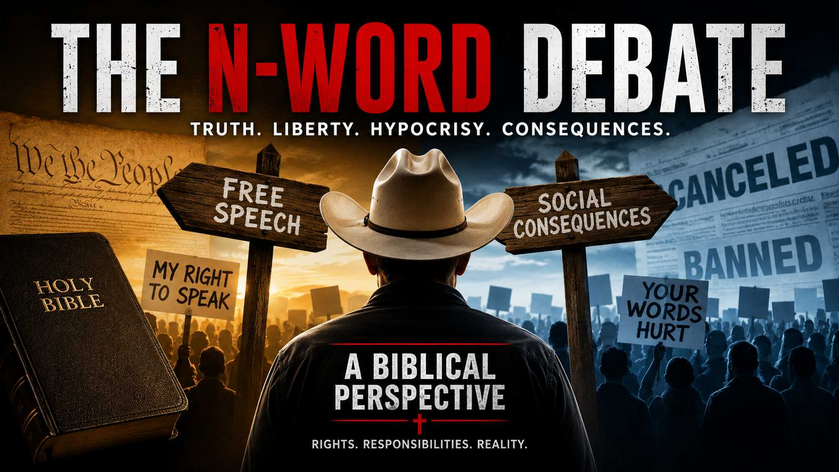
Chud the Builder and the N-Word Debate: Truth, Liberty, Hypocrisy, and Consequences
A Biblical and Constitutional Examination of Free Speech, Cultural Double Standards, Provocation, and Social Consequences in Modern America

Introduction

In an age shaped by viral media, outrage culture, and social division, society is increasingly confronted with speech designed to provoke emotional reactions, generate attention, challenge cultural norms, and expose perceived contradictions within the public square. One modern example is the online figure known as “Chat the Builder,” a white content creator known for publicly using the racial slur commonly referred to as the N-word for shock value, controversy, and online engagement.

At first glance, the issue appears simple: many people hear the word, view it as hateful and offensive, and believe its use should carry social consequences. Yet beneath the surface lies one of the more complicated modern debates surrounding free expression, morality, culture, individual liberty, social standards, hypocrisy, provocation, and the boundaries of acceptable speech in a free society. The controversy surrounding Chat the Builder forces society to wrestle with difficult questions that do not lend themselves to easy or emotionally satisfying answers.

Can a society consistently condemn a word while simultaneously commercializing and normalizing variations of it in entertainment, music, and everyday speech? Can offensive language be both socially harmful and legally protected at the same time? Does defending someone’s right to speak imply moral approval of what is being said? Do private businesses and platforms possess the right to remove speech they believe harms their environment, even while broader constitutional principles protect offensive expression from government suppression? And perhaps most importantly, should moral standards be rooted in emotional reaction, evolving cultural norms, biblical truth, or some combination of all three?

Part of what makes this issue uniquely difficult is that multiple motivations are often conflated together. Some individuals defend provocative speech from a principled belief in liberty and free expression. Others react emotionally because of the historical pain associated with the language. Others see the issue primarily through the lens of cultural hypocrisy and inconsistent standards. Still others intentionally provoke outrage in order to challenge norms, gain attention, expose contradictions, or attempt to shift future cultural boundaries by repeatedly violating current ones.

This paper recognizes that many people (including some who support or sympathize with Chat the Builder’s broader arguments) do so for very different reasons. Not all motivations are biblical. Not all are constitutional. Not all are morally grounded. Some are driven by conviction, some by emotion, some by resentment, some by provocation, and some by a genuine concern over inconsistent social standards and selective outrage. Untangling these competing motivations is part of what makes this issue such an important and revealing cultural study.

Accordingly, this paper seeks to establish a principled position rooted in biblical truth, constitutional liberty, moral consistency, and cultural accountability. It neither endorses racially inflammatory behavior nor embraces censorship as the primary solution to offensive speech. Instead, it approaches the issue honestly and carefully, recognizing that a free society must balance liberty with responsibility, truth with consistency, and the right to speak with the right of others to reject, criticize, or disassociate from speech they believe undermines the culture they wish to preserve.

I. A Biblical Foundation: Words Carry Moral Weight

Scripture teaches that words are powerful and morally consequential.

“Death and life are in the power of the tongue: and they that love it shall eat the fruit thereof.” — Proverbs 18:21

The Bible repeatedly warns against speech intended to degrade, humiliate, provoke hatred, or stir division among people made in the image of God.

“Let no corrupt communication proceed out of your mouth, but that which is good to the use of edifying, that it may minister grace unto the hearers.” — Ephesians 4:29

From a biblical perspective, racial contempt, mockery, or speech designed to inflame hostility violates the command to love one’s neighbor and honor the dignity inherent in every human being.

The historical “ER” version of the N-word carries undeniable associations with slavery, segregation, racial humiliation, and dehumanization. Those origins are morally evil and historically inseparable from the suffering attached to the term. Christians should not trivialize that history.

At the same time, modern culture has introduced complexity into the issue. The “GA” variation of the word has become normalized within portions of music, entertainment, and casual speech. This creates a cultural tension that many recognize but struggle to address consistently.

Some therefore argue that society has created a double standard: one group may publicly use a term while another group is condemned absolutely for uttering it. Figures like Chat the Builder appear to exploit this contradiction deliberately (both for attention and to expose what they perceive as cultural inconsistency).

Recognizing this contradiction, however, does not require endorsing the behavior itself.

II. Free Speech and Moral Responsibility

A free society must distinguish between what is legal and what is wise.

The principle of free speech exists precisely to protect unpopular, offensive, or controversial expression. Defending someone’s legal right to speak does not require agreement with the content of that speech.

This distinction is critical.

A person may have the constitutional liberty to say offensive things, while others simultaneously retain the liberty to criticize, avoid, remove, demonetize, or disassociate from that person.

Freedom of speech is not freedom from consequences.

From a constitutional perspective, the government should exercise extreme caution before restricting speech merely because it is offensive. The First Amendment was designed to protect speech that society dislikes, not merely speech that society approves.

However, private communities, businesses, platforms, and individuals also possess associational rights. If a platform, venue, or audience concludes that a person’s behavior is disruptive, inflammatory, or harmful to the environment they wish to cultivate, they may choose not to host or support that individual.

This is not necessarily censorship in the constitutional sense; it is often a social or institutional judgment about standards and community expectations.

III. The Cultural Reality of Provocation

Provocative speech generates clicks, attention, emotional reactions, and financial incentives. Public figures who intentionally use inflammatory language often understand that controversy itself has become a form of currency.

In many cases, the goal is not meaningful dialogue but escalation.

This does not excuse the conduct, but it explains why such behavior proliferates online.

The deeper issue is not merely one man using a word. It is a culture increasingly addicted to outrage, tribalism, and spectacle.

A society that commercially rewards provocation should not be surprised when provocateurs emerge.

IV. A Consistent Principle

The position expressed here is grounded in the following principles:

  1. Every person possesses inherent dignity because all people are created in the image of God.
  2. Speech intended primarily to demean, inflame racial hostility, or provoke division is morally irresponsible and socially destructive.
  3. The historical “ER” racial slur carries uniquely painful historical associations that should not be dismissed lightly.
  4. Society should honestly acknowledge the cultural contradictions surrounding selective normalization of racial language.
  5. Defending free speech means defending even offensive speech from government suppression.
  6. Defending free speech does not obligate private individuals, businesses, audiences, or communities to support, platform, or celebrate that speech.
  7. Citizens possess both the liberty to speak and the liberty to disassociate.

V. An Analogy for Understanding the Position

A useful analogy is the principle of fire.

Fire can provide warmth, light, and utility. But when used recklessly or maliciously, it can also damage people and communities.

A free society allows people to possess fire because liberty carries risk. Yet communities also establish boundaries when someone uses fire irresponsibly in crowded spaces.

Likewise, speech in a free society includes the possibility of offense. Protecting liberty means tolerating speech we may strongly dislike. But communities are also justified in responding when speech appears intentionally inflammatory, disruptive, or harmful to social order.

The existence of consequences does not negate freedom. Rather, freedom and responsibility coexist.

VI. the Conservative TAKE and Biblical Perspective

From a biblical worldview, every human being is created in the image of God and possesses equal dignity and moral value before Him. Scripture teaches that God “...hath made of one blood all nations of men for to dwell on all the face of the earth...” (Acts 17:26), meaning humanity is fundamentally one people under God rather than permanently divided into categories of human worth based upon appearance, ethnicity, or cultural identity. Christians therefore should reject hatred, favoritism, tribalism, and partiality in every form. The ultimate standard for truth is not social outrage, political ideology, or internet culture, but biblical truth itself.

The controversy surrounding Chat the Builder highlights a deeper contradiction within modern American culture. On one hand, the N-word(particularly the “ER” version) is treated as one of the most offensive words in the English language because of its historical association with slavery, segregation, humiliation, and racial hatred. On the other hand, society simultaneously normalizes variations of the same word in music, entertainment, comedy, and everyday speech depending upon who is saying it. This creates an inconsistent moral framework where the acceptability of language is determined less by the word itself and more by the perceived racial identity of the speaker. From a biblical and logical standpoint, moral standards should be impartial and consistent. Either degrading language is wrong for everyone, or society must acknowledge that the issue is culturally conditional rather than morally absolute.

This contradiction is part of what provocative figures like Chat the Builder appear to be exposing. A widely circulated clip demonstrates this tension clearly. In the video, Chat the Builder approaches an older man wearing a cowboy hat outside a venue and explains that he is being removed because of statements he made online involving use of the N-word. The older man responds calmly, explaining that he has Black family members or loved ones and that he understands why the establishment would not want such behavior associated with its environment. Chat the Builder then repeats the slur directly to the man’s face, after which the older man calls security to have him removed. As he is escorted away, Chat the Builder remarks, “People like this is why the country is the way that it is.”

Ironically, the clip itself demonstrates the very principle at the center of this debate: freedom of speech and freedom of association coexist together. Chat the Builder had the legal ability to say what he said. But the business, the patrons, and the individuals around him equally possessed the right to reject, remove, and disassociate from behavior they viewed as inflammatory, disruptive, or offensive. Freedom of speech does not guarantee public approval, private platform access, or immunity from social consequences.

At the same time, terms should be defined carefully and responsibly. In modern discourse, the word “racist” is often used broadly and emotionally, sometimes applied to anyone who violates a cultural boundary or uses racially insensitive language. Historically and morally, racism is better understood as genuine hatred, contempt, or belief in superiority or inferiority based solely upon ethnicity or physical appearance. Not every offensive, provocative, or attention-seeking act necessarily proves deep racial hatred. There is a meaningful distinction between someone who genuinely despises another group of people and someone intentionally provoking outrage, challenging social norms, or exposing perceived hypocrisy for reaction and attention. Society should be careful not to collapse every controversial act into the harshest moral category automatically.

At the same time, Scripture teaches that all people are flawed and capable of prejudice, resentment, tribalism, and partiality apart from moral restraint and truth. No ethnic or cultural group is morally exempt from this reality. Christians therefore should reject collective guilt, racial hostility, and selective moral outrage wherever they appear.

Biblically, liberty does not remove responsibility. Ephesians 4:29 commands believers to avoid corrupt speech and instead use words that edify others. Proverbs 18:21 teaches that “death and life are in the power of the tongue.” Therefore, while the principle of free speech should be defended and government censorship approached cautiously, Christians are not obligated to celebrate speech whose primary purpose is humiliation, outrage, provocation, or division for attention and profit.

Ultimately, the biblical position is not censorship, racial tribalism, or selective outrage. It is truth, consistency, equal standards, personal responsibility, and human dignity under God. Christians should reject genuine hatred wherever it appears, acknowledge cultural hypocrisy honestly, preserve lawful liberty, and remember that words carry both freedom and consequence. A healthy society requires both the right to speak freely and the right of others to walk away, reject, or disassociate from speech they believe harms the culture they wish to uphold.


Read full Article
post photo preview
How America Can Win the AI Race Without Taking Away People’s Property Rights

Executive Summary

The United States is entering a new industrial era driven by artificial intelligence. AI is no longer just software. It is physical infrastructure: power generation, transmission lines, semiconductor manufacturing, fiber networks, cooling systems, and large-scale data centers.

As investor and entrepreneur Kevin O'Leary recently argued, the real value in AI may not just be in the models themselves, but in the “picks and shovels” — energy, land, power, and infrastructure.

The challenge is this:

America must rapidly build AI infrastructure to remain competitive against China and Russia without violating constitutional protections for private property, local communities, and state sovereignty.

This white paper proposes a constitutional framework that balances:

  • National security

  • Technological leadership

  • Property rights

  • Energy independence

  • Federalism

  • Economic growth

The guiding principle is simple:

America should lead the AI century without becoming a centralized technocracy that crushes citizens’ land rights and local communities.

I. Why AI Infrastructure Is a National Security Imperative

A. AI Is the New Strategic Resource

In the 20th century, industrial power depended on:

  • Oil

  • Steel

  • Railroads

  • Manufacturing

In the 21st century, strategic dominance depends on:

  • Compute power

  • Data centers

  • Energy production

  • Semiconductor supply chains

  • AI models

  • Cybersecurity infrastructure

The nation that controls AI infrastructure will control:

  • Military logistics

  • Intelligence analysis

  • Cyber defense

  • Financial systems

  • Autonomous weapons

  • Pharmaceutical discovery

  • Industrial productivity

Failure to build domestic AI infrastructure risks dependence on foreign adversaries.

B. China’s State-Driven AI Expansion

China is aggressively subsidizing:

  • State-backed data centers

  • AI chip manufacturing

  • Nuclear and coal power expansion

  • Strategic mineral acquisition

  • AI military integration

Unlike the United States, China can centrally seize land and redirect resources without constitutional limitations.

America must compete without abandoning liberty.

That means:

  • Faster permitting

  • More domestic energy

  • Private-sector incentives

  • Constitutional safeguards

—not authoritarian central planning.

C. Russia and Cyber Warfare

Russia continues investing in:

  • AI-enabled cyber warfare

  • Information operations

  • Infrastructure attacks

  • Autonomous military systems

AI superiority increasingly determines:

  • Defensive capability

  • Intelligence speed

  • Economic resilience

An underpowered America becomes strategically vulnerable.

II. Core Constitutional Principles

A. The Fifth Amendment Must Remain Supreme

Private property rights are foundational to the American constitutional order.

Any AI infrastructure policy must comply with:

  • Due process

  • Just compensation

  • Limited government

  • Equal protection

No federal agency should possess unlimited authority to seize private land for corporate AI projects.

B. AI Infrastructure Is a Public Necessity — But Rights Still Matter

The Constitution already allows limited eminent domain for:

  • Roads

  • Rail

  • Utilities

  • National defense

AI infrastructure may qualify as a strategic national utility in narrowly defined circumstances.

However:

  • Eminent domain must be the last resort

  • Voluntary market transactions must be prioritized

  • Communities must receive tangible economic benefit

III. Proposed “AI Infrastructure Bill of Rights”

Section 1 — Voluntary Acquisition First

Federal law should require:

  1. Good-faith private negotiation

  2. Independent land appraisals

  3. Transparent project disclosure

  4. Community hearings

  5. State-level review

before any eminent domain action may begin.

Section 2 — Supermajority Approval Requirement

Any federal eminent domain action for AI infrastructure should require:

  • Congressional authorization

  • A supermajority vote

  • Judicial review

This prevents abuse by unelected agencies.

Section 3 — Enhanced Compensation Standards

If eminent domain occurs, compensation should exceed ordinary market value.

Landowners should receive:

  • 200–400% of fair market value

  • Relocation assistance

  • Tax exemptions on compensation

  • Revenue-sharing options

  • Equity participation opportunities

This transforms forced displacement into wealth creation.

Section 4 — Property Value Protection Zones

Nearby homeowners negatively affected by:

  • Transmission lines

  • Industrial cooling systems

  • Noise

  • Environmental concerns

should receive:

  • Guaranteed property value insurance

  • Annual impact compensation

  • Tax reductions

  • Infrastructure improvements

No citizen should bear uncompensated collateral damage.

IV. National AI Development Zones

A. Preferred Siting Strategy

The federal government should prioritize:

  • Federal land

  • Brownfield industrial sites

  • Decommissioned military bases

  • Underused commercial corridors

  • Energy-rich rural zones seeking development

This minimizes conflict with residential communities.

B. State Partnership Model

States should voluntarily opt into:

“National AI Development Zones”

Benefits include:

  • Federal energy grants

  • Nuclear modernization support

  • Semiconductor investments

  • Workforce training

  • Broadband expansion

  • Tax revenue sharing

States retain substantial authority over:

  • Zoning

  • Environmental review

  • Labor standards

  • Local infrastructure

V. Energy Policy for AI Dominance

A. AI Requires Massive Energy Expansion

Modern AI systems consume enormous electricity.

America cannot dominate AI while restricting:

  • Natural gas

  • Nuclear energy

  • Grid modernization

  • Domestic mining

  • Transmission buildout

AI competitiveness is now directly tied to energy abundance.

B. Strategic Energy Recommendations

1. Accelerate Nuclear Development

Support:

  • Small modular reactors (SMRs)

  • Next-generation nuclear

  • Defense-linked microgrids

2. Modernize the Grid

Invest in:

  • Transmission corridors

  • Grid redundancy

  • Cybersecurity hardening

3. Expand Domestic Natural Gas

Reliable baseload power remains essential for AI infrastructure.

4. Secure Semiconductor Supply Chains

Reduce dependence on foreign manufacturing.

VI. Anti-Monopoly and Anti-Oligarchy Protections

A. Prevent “AI Feudalism”

A handful of corporations should not control:

  • National compute infrastructure

  • Energy access

  • Government AI contracts

  • Digital speech systems

Competition safeguards are necessary.

B. Infrastructure Neutrality Rules

Critical AI infrastructure receiving federal support should operate under:

  • Equal-access standards

  • Transparent pricing

  • Non-discrimination requirements

This prevents infrastructure monopolies.

VII. Rural Prosperity Strategy

AI infrastructure can revitalize struggling regions.

Potential benefits:

  • High-paying technical jobs

  • Energy investment

  • Local tax revenue

  • Manufacturing growth

  • Broadband expansion

Communities hosting AI infrastructure should receive:

  • Revenue participation

  • Long-term tax sharing

  • Workforce academies

  • Utility upgrades

The goal is partnership, not extraction.

VIII. Civil Liberties and Surveillance Limits

AI infrastructure expansion must not become a pretext for:

  • Mass surveillance

  • Social credit systems

  • Political censorship

  • Centralized digital control

Explicit constitutional guardrails should prohibit:

  • Federal AI censorship coordination

  • Warrantless AI monitoring

  • Political discrimination algorithms

America must outcompete authoritarian systems without becoming one.

IX. the Conservative TAKE

The United States faces a defining challenge:

Build the infrastructure necessary to dominate the AI age while preserving the constitutional liberties that distinguish America from authoritarian rivals.

China can seize land by decree.
Russia can centralize strategic industries through state force.

America’s advantage is different:

  • Free enterprise

  • Innovation

  • Property rights

  • Federalism

  • Constitutional limits

The solution is not to halt AI development.
The solution is to build intelligently, constitutionally, and competitively.

If America combines:

  • abundant energy,

  • secure infrastructure,

  • constitutional protections,

  • and market-driven innovation,

it can lead the AI century without sacrificing the rights of its citizens.

Read full Article
See More
Available on mobile and TV devices
google store google store app store app store
google store google store app tv store app tv store amazon store amazon store roku store roku store
Powered by Locals