the Conservative TAKE
Politics • Culture • News
Trump’s Deportation Play: Right Move, Stronger Foundation
post photo preview

A recent article titled "Trump’s Deportation Play: Right Goal, Wrong Move" argues that President Trump’s use of the Alien Enemies Act (AEA) of 1798 to deport alleged members of the Venezuelan gang Tren de Aragua is legally and strategically flawed. However, this argument misunderstands the constitutional authority of the executive branch, the validity of the AEA, and the role of the judiciary in national security matters. Let’s break it down point by point.

The Alien Enemies Act Is Not a Stretch, It’s the Law

The claim that the AEA is meant only for wars between nations ignores the text of the statute itself. The law grants the President the power to act against foreign nationals during times of conflict or invasion not just in declared wars. The article dismisses the idea that Tren de Aragua qualifies under this law, but that argument ignores the evidence that Venezuela’s government facilitated their entry into the U.S.. When a criminal force enters the country with state backing or direction, it meets the criteria for a “predatory incursion” under the AEA.

Furthermore, the argument that the AEA is "outdated" is legally meaningless. The U.S. Constitution itself is older than the AEA; does that mean it’s no longer valid? A law remains enforceable unless repealed, and the AEA has never been struck down or repealed by Congress. It is still part of the legal framework for national security.

Judicial Overreach Is the Real Issue

The article claims that Trump’s use of the AEA gave activist judges an easy legal excuse to block him. But the bigger issue is judicial overreach. Federal courts do not have unlimited power to interfere with executive national security decisions. The President, not unelected district judges, is responsible for national defense. The judiciary’s role is to interpret the law, but courts cannot seize executive powers that the Constitution explicitly grants the Commander-in-Chief.

The courts did not stop the Biden administration from mass-releasing illegal aliens, yet they now block a president from removing dangerous foreign criminals. This double standard is a constitutional crisis, and Trump is addressing it by using laws that Congress has already passed.

Existing Immigration Laws? Not a Better Option

The article argues that Trump should have relied on existing immigration laws instead of invoking the AEA. But immigration courts are already overwhelmed, and activist judges often block deportations on technicalities. Waiting for years of litigation is not a real solution; it’s an excuse for inaction.

The suggestion that Trump should have sent Tren de Aragua members to Guantanamo Bay instead does not solve the legal issue. If judges are willing to block deportations now, they would also find ways to challenge Guantanamo detentions. The President’s approach of invoking a clear, existing statute that does not require endless court battles is legally sound and ensures immediate action.

Trump Is Following the Law, Not Bending It

The article suggests that Trump is setting a dangerous precedent by using a national security law for deportations. But this argument is backwards. The real danger is allowing courts to override the President’s constitutional authority to defend the country.

Trump’s move is not about political optics. It is about restoring executive authority that has been eroded by activist judges and bureaucratic delays. The Constitution does not give federal judges command over immigration enforcement. The President is acting well within his authority to remove foreign threats without having to litigate every single case for years in immigration courts.

In other words...

Tren de Aragua must be deported, and President Trump has the legal and constitutional power to do so under the Alien Enemies Act. The judicial overreach that has stalled deportations for years is the real crisis, and Trump’s actions are a direct challenge to a broken system that has failed to protect American citizens.

Ignoring the clear text of the AEA, misrepresenting the President’s constitutional role, and claiming that existing immigration laws would have made this easier are flawed arguments that do not hold up to scrutiny. If the courts continue to interfere with the President’s national security decisions, Congress has the power to check the judiciary through impeachment, defunding, or restructuring lower courts. The separation of powers must be restored, and enforcing the law as written is the only way to do it.


Legal Precedents & Laws That Support Trump’s Authority

  1. Alien Enemies Act of 1798 – Grants the President power to detain or deport nationals of hostile nations during times of invasion or conflict. Still valid and in effect today.

  2. Haig v. Agee (1981) – Supreme Court ruled that the President has broad authority in national security matters, including actions against foreign threats.

  3. Youngstown Sheet & Tube Co. v. Sawyer (1952) – While limiting executive power in domestic matters, the ruling affirmed that the President has greater authority in foreign affairs and national security.

  4. Knauff v. Shaughnessy (1950) – The Supreme Court held that the executive branch has plenary power over the admission and exclusion of aliens, and that courts should not interfere with national security decisions.

  5. Trump v. Hawaii (2018) – The Court reaffirmed that the President has broad discretion to exclude foreign nationals from the U.S. when national security is at stake.

  6. Congress’s Power Over the Judiciary – The Constitution gives Congress the ability to remove lower courts, limit their jurisdiction, defund them, or impeach judges who abuse their authority. This is a legitimate constitutional check when courts overstep their bounds.


President Trump is enforcing a law written by the Founding Fathers, not twisting legal boundaries. The real constitutional crisis isn’t his enforcement of immigration laws. It’s the judiciary’s overreach into executive national security decisions. The Commander-in-Chief has the authority and obligation to protect the nation from foreign threats, and Congress has the power to rein in activist judges when they obstruct that duty for political reasons.

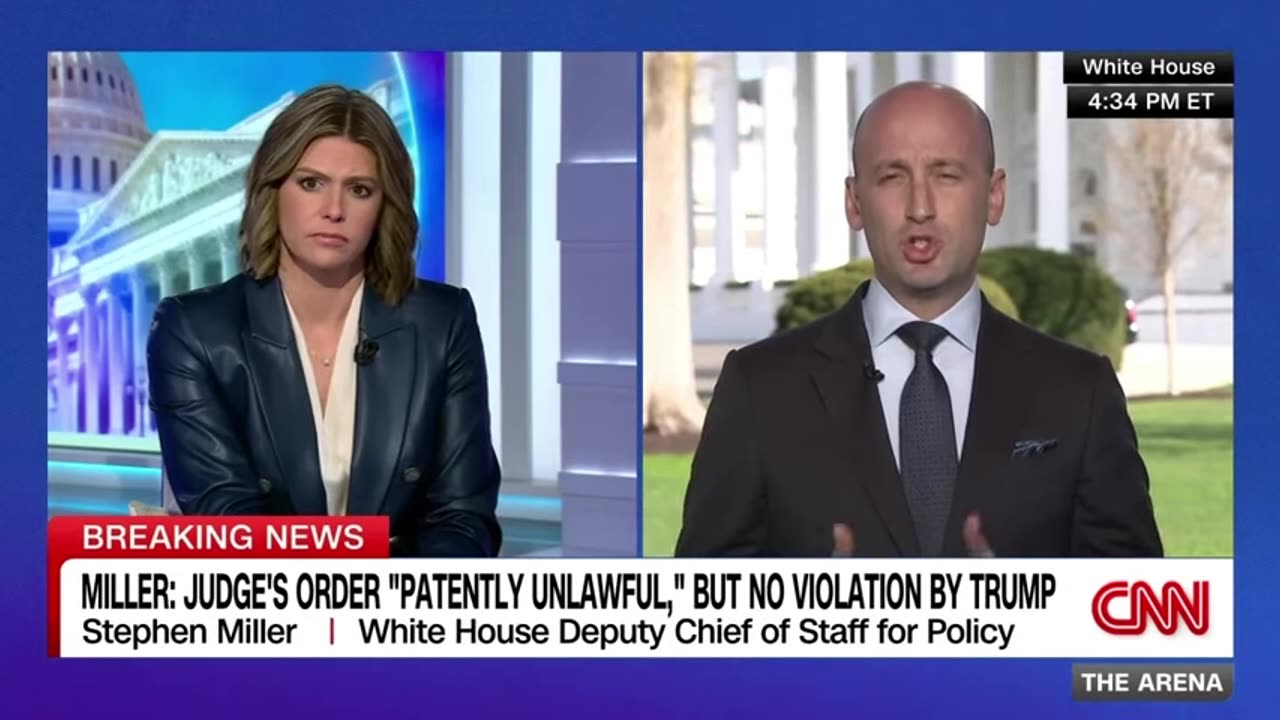
As Stephen Miller laid out in his recent interview (watch here), the Alien Enemies Act of 1798 gives the President clear and unquestionable authority to remove foreign threats without interference from unelected judges. In the interview, Miller obliterates a CNN reporter, exposing their misrepresentation of the law and refusal to acknowledge the President’s constitutional powers. When pressed, the reporter couldn’t even answer basic legal questions about whether a district judge has the right to direct troop movements, because they do not.

This is not a legal gray area; the Constitution is clear. Allowing a single judge to override the President’s national security decisions is not law and order—it’s legal chaos.

placeholder


community logo
Join the the Conservative TAKE Community
To read more articles like this, sign up and join my community today
0
What else you may like…
Videos
Posts
Articles
Odds of Love: A Probability Study Proving Jasmine Crockett’s Race Baiting Ignores the Real Challenges of Finding a Conservative Black Match

EXECUTIVE SUMMARY

Representative Jasmine Crockett’s recent criticism of Representative Byron Donalds for marrying a white woman highlights a regressive mindset steeped in ignorance and racial bias, casting doubt on her ability to engage with the diverse realities of American life.

https://x.com/EricLDaugh/status/1906302926571618409

By implying that Donalds has been “whitewashed” through his interracial marriage, Crockett clings to outdated stereotypes that dictate racial loyalty over personal agency, exposing her own hypocrisy in advocating for equality while policing others’ private choices. This narrow perspective stands in stark contrast to the evolving dynamics of relationships across racial lines, as evidenced by a probabilistic analysis of partner selection among conservative Black individuals. To illustrate the complexity of such dynamics, consider the following study estimating the likelihood of a conservative Black man finding and marrying a conservative Black woman who aligns with his values—a scenario Crockett might deem more “acceptable,” yet one fraught with its own...

00:00:46
00:01:20
Biblical Citizenship in Modern America Commentary Ep14 - Understanding the Times 3

00:00 Introduction
02:03 Week 13 review
04:56 Our Current Education System
05:59 Six Verbs for Advancing Truth in the Country
09:08 What Our Elected Officials Don't Know About America
10:44 The Foundation of Law
12:12 Who Were the Signers of the Declaration of Independence?
13:52 Benjamin Rush
15:44 What is Patriotism?
18:34 Summary of Workbook

00:25:36
MN: ICE is not LEAVING

The left is trying to make it seem like Trump is abandoning Minnesota, but that’s misleading. What’s actually happening is that the large-scale “Operation Metro Surge” is being wound down because its primary objectives were met. ICE is now shifting to a more targeted approach...picking up deportable individuals directly from prisons and jails or at the point of release...so the massive street-level surge is no longer necessary.
Tom Homan announced on February 12, 2026, that he proposed ending the surge operation, and Trump agreed. But that doesn’t mean enforcement is stopping. It means it’s transitioning from a peak deployment of thousands of agents to a smaller, more focused presence...closer to normal staffing levels.
The operation resulted in over 4,000 arrests, many involving individuals with criminal records. Homan also emphasized improved cooperation with Minnesota state and local authorities, giving ICE greater access to county jails and state prisons. That ...

The left is trying to make it seem like Trump is abandoning Minnesota, but that’s misleading. What’s actually happening is that the large-scale “Operation Metro Surge” is being wound down because its primary objectives were met. ICE is now shifting to a more targeted approach...picking up deportable individuals directly from prisons and jails or at the point of release...so the massive street-level surge is no longer necessary.
Tom Homan announced on February 12, 2026, that he proposed ending the surge operation, and Trump agreed. But that doesn’t mean enforcement is stopping. It means it’s transitioning from a peak deployment of thousands of agents to a smaller, more focused presence...closer to normal staffing levels.
The operation resulted in over 4,000 arrests, many involving individuals with criminal records. Homan also emphasized improved cooperation with Minnesota state and local authorities, giving ICE greater access to county jails and state prisons. That ...

So far, President Trump, in the short time of his second stint, has delivered on every single promise of the America First coalition (most of which was codified in the OBBB), all but one. That remaining pillar represents perhaps the largest wing of the MAGA populist movement; the millions who want justice and accountability for the Deep State.

It seems Trump set a brilliant trap with his apparent ambivalence toward the Epstein files. Anyone paying attention, and not listening to the lamestream media, knows the exact opposite has been true for more than a decade. He has been orchestrating this moment. And now, people are already retiring, lawyering up, and running for cover as the latest email drops implicate not only the Clinton administration, but also Biden and even Obama.

The Democrats and their slimy media cronies just can’t help themselves. In trying to hurt Trump, they’ve unleashed the Kraken on their own allies; the very people who have lived in the shadows, protected from ...

DRAFT - Operation Epic Fury and the Remaking of the Middle East

To be released after noon of 3/2/26

**DRAFT**


On February 28, 2026, the United States and Israel launched one of the most coordinated and strategically ambitious military campaigns in modern Middle Eastern history. The U.S. named its campaign Operation Epic Fury. Israel called its parallel effort Operation Roaring Lion. But this was not simply another round of airstrikes. It was a systemic attempt to decapitate, degrade, and potentially collapse the core of the Iranian regime.

Only for Supporters
To read the rest of this article and access other paid content, you must be a supporter
Read full Article
post photo preview
SCOTUS Decision Changes Less Than the Media Claims

Let's chill.

There’s a lot of noise today about the Supreme Court striking down some Trump tariffs. Let’s simplify this.

The Court did not strike down all of President Trump’s tariffs. It ruled that one specific law (the International Emergency Economic Powers Act (IEEPA)) wasn’t the proper statute for those particular tariffs.

That’s it.

This wasn’t a ruling against tariffs in general. It wasn’t a statement that the President lacks tariff authority. It was a technical decision about which law can be used.

Most of the Trump-era tariffs remain in place, especially those based on national security and unfair trade practices. This is key and was what he ran on.

What Trump Can Do

What Congress Can Do

  • Clarify that IEEPA includes tariff authority.

  • Expand or reaffirm existing trade delegation statutes.

  • Pass legislation directly authorizing specific tariffs.

  • Codify current tariff structures to remove future legal challenges.

This is not a collapse of trade policy. It’s a narrowing of one legal pathway.

The tools are still there. The authority still exists. The strategy simply adjusts.


Read full Article
Lafayette: The Fire and the Fog

Act 1: Foundations and Fault Lines

In a quiet chateau nestled in the green hills of Auvergne, a boy was born into a name older than most nations. Marie-Joseph Paul Yves Roch Gilbert du Motier—known simply as Gilbert to those who loved him—would grow to be one of history’s most celebrated revolutionaries. But from the very start, Lafayette's world was one of contradictions.

He was born into nobility, yet surrounded by stories of poverty and loss. His father, a decorated grenadier, was killed by a British cannonball before Lafayette ever saw his face. His mother, devastated by grief, fled to Paris, leaving young Gilbert to be raised by his stern but kind grandmother in the countryside. She taught him duty, discipline, and stories of battlefield glory. Under the watchful eyes of abbés and aristocrats, Lafayette soaked in the values of the French Enlightenment. Reason, liberty, the rights of man—these became the drumbeat of his youth.

But knowledge alone doesn’t make a man wise.

From the halls of Paris to the salons of Versailles, Lafayette learned to charm and maneuver. He married Adrienne de Noailles, a fourteen-year-old girl from one of France’s most powerful families. At sixteen, Lafayette was rich, married, and well on his way to joining the king’s elite guard. But behind the courtly elegance, something restless stirred in his heart. He longed for purpose—glory, as he called it. The kind that would echo through time.

So when whispers of rebellion across the Atlantic reached his ears, he was enthralled. America, a land fighting for liberty against the British—the very empire that had taken his father—became an obsession. Even when King Louis XVI forbade it, Lafayette defied him, sneaking across the sea to join George Washington’s struggling army.

From a worldly point of view, it was heroic. A young man leaving behind wealth, a pregnant wife, and privilege to fight for strangers. But beneath the idealism, there was a flaw—a subtle one, but dangerous.

Lafayette believed that man could save himself.

Through reason. Through revolution. Through liberty unanchored from any higher truth.

He didn’t yet understand what the Bible makes clear: that the heart of man is “deceitful above all things” (Jeremiah 17:9), and that liberty without virtue is just another form of chaos. Lafayette loved the idea of freedom, but he lacked a framework that could keep that freedom from becoming an idol. He was, in many ways, a knight in search of a cause—but without a compass pointing to God's moral order.

While Lafayette crossed the Atlantic in search of glory, Adrienne was left behind in Paris, pregnant and alone. She received glowing letters—tales of cannons and courage—but little concern for her own trials. She had married a boy still chasing the ghost of a father he barely knew.

In America, Lafayette was welcomed… reluctantly. The Continental Congress had seen too many glory-seeking Europeans hoping to play general. At first, they dismissed him. But when Lafayette offered to serve without pay, and when they read letters of praise from Benjamin Franklin, they reconsidered. Lafayette was given the honorary title of major-general—though he would command no troops.

He met George Washington soon after, and an unexpected friendship blossomed. Washington, a man of discipline and restraint, took the fiery Frenchman under his wing. Lafayette found in Washington a father figure, and in the American cause, a sense of belonging.

But even as Lafayette fought bravely in battle—earning respect and even suffering wounds—he never stopped chasing applause. And back in France, Adrienne suffered silently, raising children alone, enduring gossip about Lafayette’s rumored mistresses, and using her influence to protect his reputation.

She loved him. He often forgot to love her in return.

The story of Lafayette was already being written in two parallel threads: the public hero, adored on two continents, and the private man, blind to the cost others paid for his ambitions.

Even his noblest efforts—his fight for liberty, his calls to end slavery, his dreams of global reform—were built on a foundation that was subtly cracked.

He believed, as many Enlightenment thinkers did, that humanity was basically good, that progress was inevitable, and that the right ideas could fix the world.

But history—and Scripture—tell a different story.

"Unless the Lord builds the house, the builders labor in vain." (Psalm 127:1)

Lafayette’s foundation was bold. But it wasn’t biblical.

And the storm was coming.

Let me know if you're ready for Act 2: Fallout and Fractures. It will dive into the French Revolution, betrayal from both sides, Adrienne’s suffering, and the unraveling of Lafayette’s ideals.


Act 2: Fallout and Fractures


The smell of smoke lingered in the Paris air. The Bastille had fallen. The people roared. The king trembled. And in the center of it all stood Lafayette—beloved by some, cursed by others, and no longer sure who he truly was.


Only for Supporters
To read the rest of this article and access other paid content, you must be a supporter
Read full Article
See More
Available on mobile and TV devices
google store google store app store app store
google store google store app tv store app tv store amazon store amazon store roku store roku store
Powered by Locals