the Conservative TAKE
Politics • Culture • News
Yes. Americans Are Saving More From Trump Policies Than They’re Losing to Gas Prices
A Milton Friedman Style Analysis of Taxpayer Savings vs. Rising Energy Costs (2024–2026)
post photo preview


Executive Summary

Public debate often focuses on headlines—tax cuts, gas prices, deficit claims—but misses the only question that actually matters to working Americans:

👉 Are you better off financially?

This paper answers that question using a clear, measurable test:

👉 Is the average taxpayer saving more per year from recent policy changes than they have lost due to higher gas prices over the past two years?

Using available economic data—analyzed with assistance from Grok—the conclusion is straightforward:

Yes. On average, taxpayer savings exceed increased fuel costs by a wide margin.

This analysis is grounded in the principles of Milton Friedman, who argued that economic policy should be judged not by intentions or rhetoric, but by outcomes:

Does it leave more money, freedom, and incentives in the hands of individuals—or does it expand government control?

Recent policy changes—including tax reductions, deregulation, and expanded domestic energy production—have shifted resources back toward the private sector. These changes have:

  • Increased take-home income through tax relief
  • Reduced hidden costs through deregulation
  • Strengthened incentives to work, invest, and produce

At the same time, Americans have faced real cost pressures:

  • Rising gas prices driven largely by global instability
  • Persistent inflation reducing purchasing power
  • Elevated interest rates increasing borrowing costs

When measured directly:

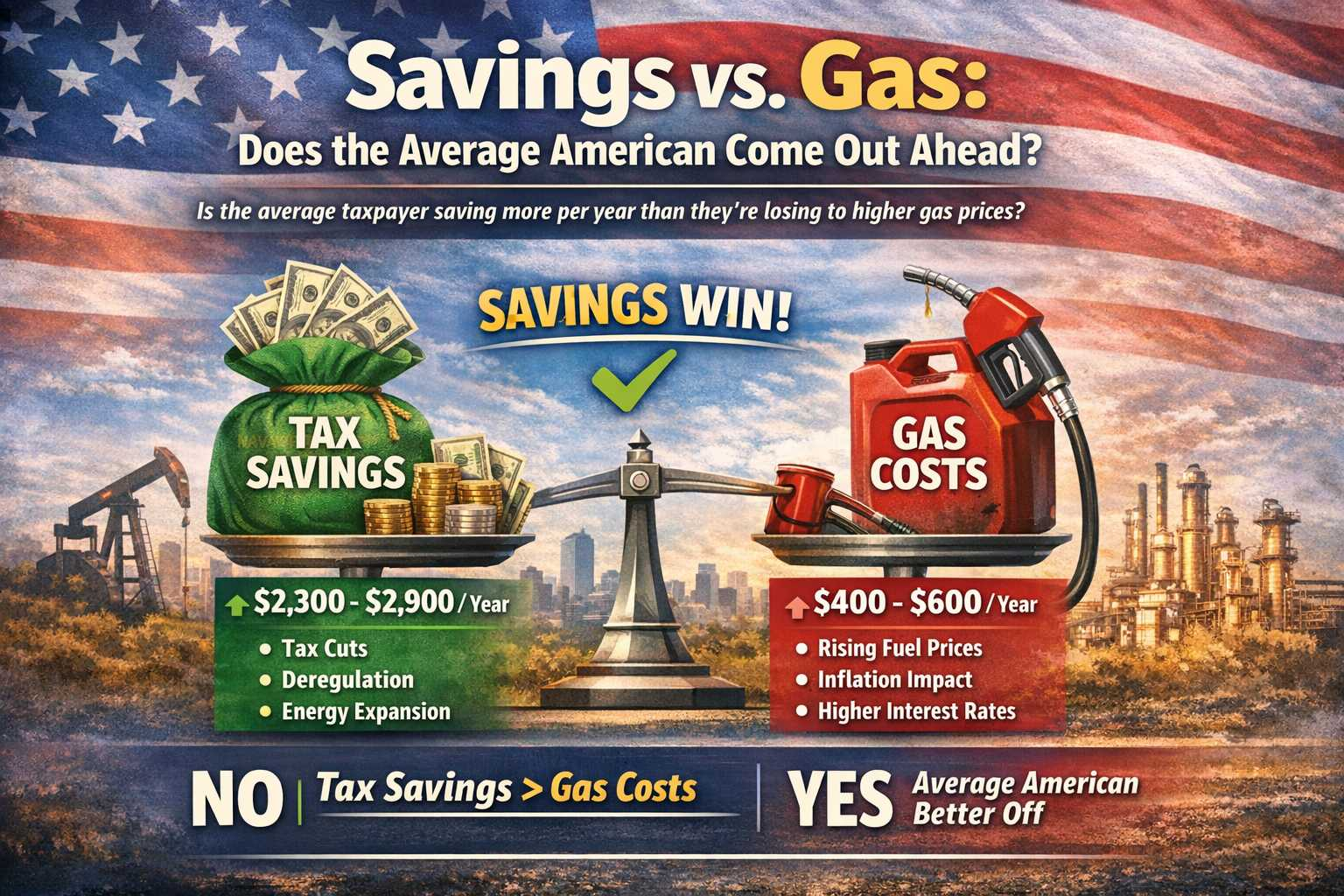
  • Taxpayer savings: ~$2,300–$2,900 annually
  • Gas cost increases: ~$400–$600 annually

👉 Savings exceed gas costs by roughly 4 to 6 times

After accounting for all major cost pressures:

👉 The average household is still modestly ahead—by approximately $100–$400 per year

This represents a net positive outcome, though not a dramatic one.

From a Friedman perspective, the direction is correct—toward freer markets and stronger incentives—but incomplete. Without meaningful spending restraint and stable monetary policy, these gains remain vulnerable over time.


1. Policy Framework and Structural Changes

The economic landscape over the past two years has been shaped by a combination of legislative and executive actions, most notably the:

One Big Beautiful Bill Act (OBBBA, H.R. 1 – July 4, 2025)

Key provisions include:

  • Permanent extension of 2017 tax cuts
  • Lower marginal tax rates
  • Increased standard deduction
  • Adjustments to the child tax credit
  • New deductions for tips and overtime income (with caps)
  • Expanded deductions for seniors
  • Temporary increase in the SALT deduction cap
  • Full or expanded business expensing

These tax changes were paired with broader structural efforts:

  • Energy deregulation (federal land access, faster permitting)
  • Reduction in regulatory burdens across industries
  • Reported $600 billion deficit reduction
  • Reduction of approximately 352,000 federal employees

Together, these policies aim to reduce government friction and increase private-sector productivity.


2. Real-World Impact on the Average Taxpayer

To understand the effects, we define the average taxpayer as:

  • Household income: ~$80,000–$85,000
  • Annual spending: ~$60,000–$65,000
  • Driving: ~13,000–14,000 miles per year

Direct Benefits

  • Tax Relief:
    Meaningful and measurable. Most households see increased take-home income.
  • Incentive Effects:
    Lower marginal rates encourage additional work, investment, and productivity.

Cost Pressures

  • Gas Prices:
    Increased due to geopolitical instability, not domestic production limits.
  • Inflation:
    ~3.3% annually, eroding purchasing power across all categories.
  • Interest Rates:
    Elevated borrowing costs for mortgages, auto loans, and credit cards.

Indirect Benefits

  • Deregulation:
    Reduces compliance costs → lowers prices indirectly.
  • Energy Production:
    Increased domestic supply reduces long-term cost pressures across the economy.

3. Hidden Economic Forces (Friedman Lens)

Friedman emphasized that the most important economic effects are often the least visible.

Inflation as a Hidden Tax

Inflation reduces real income without legislative approval.

  • ~3.3% inflation = ~$2,000+ annual loss in purchasing power

Energy as a System-Wide Cost Driver

Energy affects:

  • Transportation
  • Food production
  • Manufacturing
  • Supply chains

Lower energy costs ripple through the entire economy.


Deficit Spending

Persistent deficits:

  • Increase future tax burdens
  • Push interest rates higher
  • Crowd out private investment

4. Energy Policy and Market Response

Recent policy changes significantly expanded domestic energy production:

  • Record natural gas output (118.5 Bcf/day)
  • Strong oil production (~13.6M barrels/day)

Impact:

  • Reduced supply constraints
  • Lower embedded costs in goods and services
  • Increased economic stability

Gas Price Reality:

Recent increases are largely due to external geopolitical shocks, not domestic policy failure.

👉 Without increased domestic supply, prices would likely be higher.


5. The $600 Billion Deficit Claim — Reality Check

The reported deficit reduction is often misunderstood.

Key Findings:

  • Driven primarily by increased revenue, not spending cuts
  • Federal deficit remains near $1.9 trillion
  • Long-term debt continues to rise

👉 Conclusion:
This is not structural deficit reduction—it is temporary improvement driven by economic growth and taxation.


6. Financial Breakdown: Average Household Impact

Annual Impact (2026 Estimates)

CategoryAnnual ImpactExplanation
Direct Tax Savings+$2,300–$2,900Increased take-home income
Indirect Savings+$200–$500Lower regulatory & energy costs
Total Gains+$2,500–$3,400 
Gas Cost Increase–$400–$600Based on ~520 gallons/year
Inflation Impact–$2,000–$2,150Loss of purchasing power
Borrowing Costs–$200–$400Higher interest rates
Future Debt Burden–$300–$500Long-term economic drag
Total Costs–$2,900–$3,650 
Net Effect–$400 to +$500Central estimate: +$100–$300

7. Government Size and Economic Efficiency

  • Federal workforce reduced by 352,000 employees
  • Lowest level since 1966

Interpretation:

  • Indicates reduced administrative burden
  • Suggests improved efficiency

However:

👉 True government size = spending + regulation + mandates

Workforce reduction alone does not guarantee long-term fiscal discipline.


8. Core Question: Savings vs. Gas

👉 Has the increase in gas costs exceeded taxpayer savings?

Data-Based Answer:

  • Tax savings: $2,300–$2,900
  • Gas increases: $400–$600

👉 No. Savings exceed gas costs by 4–6 times.


9. Final Conclusion

👉 Has the increase in gas costs (based on average miles driven per taxpayer) been greater than the average tax savings per taxpayer?

No.

  • Average tax savings: $2,300–$2,900 per year
  • Average gas cost increase: $400–$600 per year

👉 Taxpayer savings exceed increased gas costs.


👉 Is the average American better off?

Yes.


Sources for the Analysis (Mid-2024 to April 2026 U.S. Economic Policy)All figures, deficit claims, tax impacts, energy production data, CPI readings, and workforce reductions cited in the analysis are drawn directly from official government reports, nonpartisan fiscal watchdogs, and primary data agencies. Here is the complete list with full URLs (plain text only, no clickable links):
  1. IRS Official Guidance on One Big Beautiful Bill Act (OBBBA) Provisions
    https://www.irs.gov/newsroom/one-big-beautiful-bill-provisions
  2. Tax Foundation – FAQ: The One Big Beautiful Bill, Explained (full tax changes and dynamic scoring)
    https://taxfoundation.org/research/all/federal/one-big-beautiful-bill-act-tax-changes/
  3. Tax Foundation – OBBBA Average Tax Cuts Impact Map ($2,300 average individual tax cut in 2026)
    https://taxfoundation.org/data/all/federal/obbba-average-tax-cuts-impact-map/
  4. Committee for a Responsible Federal Budget (CRFB) – Breaking Down the One Big Beautiful Bill (deficit impact: +$2.4T primary, +$3T with interest)
    https://www.crfb.org/blogs/breaking-down-one-big-beautiful-bill
  5. Congressional Budget Office (CBO) – Monthly Budget Review: January 2026 ($696 billion deficit first four months FY2026; revenue-driven slowdown)
    https://www.cbo.gov/publication/61977
  6. Bipartisan Policy Center – Deficit Tracker (January 2026 cumulative deficit $600 billion YoY lower after timing adjustments)
    https://bipartisanpolicy.org/report/deficit-tracker/
  7. CBO – The Budget and Economic Outlook: 2026 to 2036 (full-year FY2026 deficit projection $1.9T)
    https://www.cbo.gov/publication/62105
  8. U.S. Energy Information Administration (EIA) – U.S. natural gas production reached a new record in 2025 (118.5 Bcf/d)
    https://www.eia.gov/todayinenergy/detail.php?id=67345
  9. Bureau of Labor Statistics (BLS) – Consumer Price Index Summary, March 2026 (3.3% YoY CPI, energy +10.9%, gasoline +21.2%)
    https://www.bls.gov/news.release/cpi.nr0.htm
  10. Pew Research Center – Federal workforce shrank 10% in Trump’s first year back in office (net reductions and context)
    https://www.pewresearch.org/short-reads/2026/03/13/federal-workforce-shrank-10-in-trumps-first-year-back-in-office/
  11. Office of Personnel Management (OPM) – Workforce Changes Data (net -271k to -352k civilian reductions FY2025, lowest headcount since 1966)
    https://data.opm.gov/explore-data/analytics/workforce-changes
  12. CRFB / CBO cross-referenced OBBBA fiscal cost estimates (used for hidden future burden and crowding-out calculations)
    https://www.crfb.org/blogs/breaking-down-one-big-beautiful-bill
    (links directly to CBO scoring tables)

community logo
Join the the Conservative TAKE Community
To read more articles like this, sign up and join my community today
0
What else you may like…
Videos
Posts
Articles
Odds of Love: A Probability Study Proving Jasmine Crockett’s Race Baiting Ignores the Real Challenges of Finding a Conservative Black Match

EXECUTIVE SUMMARY

Representative Jasmine Crockett’s recent criticism of Representative Byron Donalds for marrying a white woman highlights a regressive mindset steeped in ignorance and racial bias, casting doubt on her ability to engage with the diverse realities of American life.

https://x.com/EricLDaugh/status/1906302926571618409

By implying that Donalds has been “whitewashed” through his interracial marriage, Crockett clings to outdated stereotypes that dictate racial loyalty over personal agency, exposing her own hypocrisy in advocating for equality while policing others’ private choices. This narrow perspective stands in stark contrast to the evolving dynamics of relationships across racial lines, as evidenced by a probabilistic analysis of partner selection among conservative Black individuals. To illustrate the complexity of such dynamics, consider the following study estimating the likelihood of a conservative Black man finding and marrying a conservative Black woman who aligns with his values—a scenario Crockett might deem more “acceptable,” yet one fraught with its own...

00:00:46
00:01:20
Biblical Citizenship in Modern America Commentary Ep14 - Understanding the Times 3

00:00 Introduction
02:03 Week 13 review
04:56 Our Current Education System
05:59 Six Verbs for Advancing Truth in the Country
09:08 What Our Elected Officials Don't Know About America
10:44 The Foundation of Law
12:12 Who Were the Signers of the Declaration of Independence?
13:52 Benjamin Rush
15:44 What is Patriotism?
18:34 Summary of Workbook

00:25:36
2026-03-18-substack-massie-sucks-20-plus-reasons

Thomas Massie is fake MAGA. This Trump hater was eager to shoot Trump supporters on J6, endorsed DeSantis while calling MAGA a virus, and now dodges mass deportations. Here are the sources that support our Substack note entitled "20+ Reasons Thomas Massie Why He Sucks (aka fake MAGA)"

2026-03-18-substack-massie-sucks-20-plus-reasons.pdf
MN: ICE is not LEAVING

The left is trying to make it seem like Trump is abandoning Minnesota, but that’s misleading. What’s actually happening is that the large-scale “Operation Metro Surge” is being wound down because its primary objectives were met. ICE is now shifting to a more targeted approach...picking up deportable individuals directly from prisons and jails or at the point of release...so the massive street-level surge is no longer necessary.
Tom Homan announced on February 12, 2026, that he proposed ending the surge operation, and Trump agreed. But that doesn’t mean enforcement is stopping. It means it’s transitioning from a peak deployment of thousands of agents to a smaller, more focused presence...closer to normal staffing levels.
The operation resulted in over 4,000 arrests, many involving individuals with criminal records. Homan also emphasized improved cooperation with Minnesota state and local authorities, giving ICE greater access to county jails and state prisons. That ...

The left is trying to make it seem like Trump is abandoning Minnesota, but that’s misleading. What’s actually happening is that the large-scale “Operation Metro Surge” is being wound down because its primary objectives were met. ICE is now shifting to a more targeted approach...picking up deportable individuals directly from prisons and jails or at the point of release...so the massive street-level surge is no longer necessary.
Tom Homan announced on February 12, 2026, that he proposed ending the surge operation, and Trump agreed. But that doesn’t mean enforcement is stopping. It means it’s transitioning from a peak deployment of thousands of agents to a smaller, more focused presence...closer to normal staffing levels.
The operation resulted in over 4,000 arrests, many involving individuals with criminal records. Homan also emphasized improved cooperation with Minnesota state and local authorities, giving ICE greater access to county jails and state prisons. That ...

DRAFT: GOP Takes Over the Senate Floor: SAVE Act Fight Begins
Inside the strategy, the backup plans, and the path to getting it to Trump’s desk

Something significant is unfolding in the United States Senate—and it deserves sober, clear-eyed attention.

As of today, the Senate has formally taken up debate on the SAVE Act (Safeguard American Voter Eligibility Act), a bill that already passed the House and now faces its most difficult test: the Senate’s procedural gauntlet. At its core, the legislation is straightforward. It requires proof of citizenship to register to vote and government-issued ID to cast a ballot in federal elections. In other words, it seeks to enforce what is already embedded in federal law: that only citizens may vote.

Only for Supporters
To read the rest of this article and access other paid content, you must be a supporter
Read full Article
DRAFT - A Necessary Decision: Why the Iran War Was a Risk Worth Taking

The current conflict with Iran did not emerge out of political convenience or election-year calculation. According to reporting and analysis discussed by Bill O’Reilly and Glenn Beck, the decision was driven by intelligence assessments that suggested Iran was approaching a dangerous threshold in its nuclear program and had definitively rejected negotiations to halt it.


Only for Supporters
To read the rest of this article and access other paid content, you must be a supporter
Read full Article
7 Reasons Why Panicans SUCK!
Tucker, Massie, Candace, and the Rest Still Don’t Get It – Trump’s Tech War Is Delivering the Peace They Claim to Want

Let’s call it what it is.

The “Panicans” (those loud, fear-driven conservatives like Tucker Carlson, Candace Owens, Col. Douglas Macgregor, Dave Smith, and Thomas Massie) suck at reading the room right now. They’re panicking like it’s 2003 all over again, screaming “forever war!” the second Trump hits Iran. They see missiles flying and immediately cry “Iraq! Neocons! Blood for oil!”

They’re not traitors. They’re just stuck in the past, blind to what’s actually happening, and their panic is actively hurting the America First movement at the exact moment we’re winning bigger than we have in decades.

Here’s the brutal truth they refuse to see: Trump isn’t fighting the old war. He’s ending the era of old wars. And if these Panicans would shut up for five minutes and look at the scoreboard, they’d realize this isn’t another trillion-dollar disaster . It’s the beginning of the first real peace era in our lifetime. Providence is showing up, and they’re too busy clutching their pearls to notice.

Here are 7 reasons why Panicans flat out suck.

Reason 1: They Suck Because They’re Fighting 2003 With 2026 Eyes


Panicans keep waving the bloody shirt of Iraq and Afghanistan. “Don’t get sucked in!” they yell. Seems like a cool story except that Trump isn’t doing any of that.

Operation Epic Fury didn’t send 150,000 troops to occupy Tehran. It didn’t promise democracy in a box or nation-building. It used:

  • Stealth fighters they never saw

  • Electronic warfare that blinded Iran’s entire radar grid with fake signals

  • AI targeting, precision missiles, decoy drones

Iran’s air defenses collapsed in hours. Missile factories, drone plants, command bunkers — gone. The regime’s ability to pay its terrorists and project power is being ripped out by the roots. No occupation. No forever war. Just surgical system collapse.

That’s the “techno whatever” Tucker mocks. Trump is winning with American brains and technology, not your kid’s blood in the sand. The Panicans can’t process this because their entire brand is built on hating the forever-war machine. They’re right to hate it but they’re too dumb (or too lazy) to see Trump already killed that machine.

Reason 2: They Suck Because They Ignore That Real Iranians (Starting With the Kurds) Are Already Fighting

While the Panicans cry about “no more boots on the ground,” Trump already solved that problem the smart way.

The Kurds have now launched ground operations inside Iran with major U.S. weapons. The U.S. has been quietly arming **thousands** of Kurdish fighters inside Iran since the 12-Day War in June 2025. These are the same battle-hardened Kurds Trump armed during his first term (the absolute legends who helped wipe out ISIS).

The Kurds are fierce, pro-American fighters. They’re not just one group. They are an ethnic mix that includes Sunni Muslims, Christians, Jews, and many secular people. They’re famous for their religious tolerance in a region full of fanatics.

Democrats have betrayed the Kurds repeatedly in the past. Trump never did.

And it’s not just the Kurds. The U.S. is also arming other anti-regime groups inside Iran. Reliable polling shows that about 80% of Iran’s population opposes the lunatic mullah regime.

Translation: There is zero need for American troops on the ground. We have a population inside Iran that is able, willing, and eager to fight. Team Trump has planned this like a masterclass.

The Panicans are so addicted to their Iraq trauma that they can’t see the obvious: Trump turned Iran’s own people (starting with the Kurds) into the ground force so American soldiers don’t have to be.

Reason 3: They Suck Because They Hate Trump So Much They Refuse to Read the Room

Panicans are so consumed by their seething Trump hatred that they literally refuse to look at the actual numbers on issues they personally don’t like. CBS just dropped a bombshell poll showing 76% of Americans support Operation Epic Fury if it lasts only days or weeks. That’s a straight-up 80/20 landslide, higher than support for border security.

The only hesitation in earlier polls came from fears this would become another forever war (exactly what the Panicans are screaming). But Trump promised short and decisive, the missiles are already decaying at 70-75% per day, and the American people are on board in a massive way. The Panicans don’t care. They’d rather doom-post, call it Trump’s biggest betrayal, and fracture the MAGA coalition than admit the public is with him and the plan is working exactly as sold.

They are too busy hating Trump to read a room that’s cheering.

Reason 4: They Suck Because They Think It’s “Just Iran”

The Panicans act like this is some isolated dust-up in the desert.

Iran isn’t a single country problem. It’s the **keystone** propping up the entire anti-American axis:

  • Funding Putin’s drones that slaughter Ukrainians

  • Keeping Maduro’s socialist hellhole alive in Venezuela

  • Arming every terror proxy from Hezbollah to the Houthis

Smash Iran’s oil money, factories, and command network and the whole thing cracks: Russia gets weaker in Ukraine, Venezuela’s regime starves, China loses its cheap distraction in the Middle East.

And guess what already happened? China (the same China buying 90% of Iran’s oil) quietly backed off and refused to send advanced weapons. Why? Because half their own oil comes from the Gulf. Iran is now alone. Game over.

The Panicans missed that. Too busy doom-scrolling old Iraq footage.

Reason 5: They Suck Because They’re Missing the Sunni-Israel Miracle

Sunni Arab powerhouses (Saudi Arabia, UAE, Bahrain, Jordan, Egypt) are now openly working with Israel. Trade deals. Tech sharing. Intelligence. Joint ops against the same Iranian threat. The Abraham Accords didn’t just survive, they’re exploding into something historic.

A generation ago this was impossible. Sunni Muslims and Jews teaming up? Now it’s happening because they all finally agree: the real enemy is Tehran, not each other.

This isn’t endless war. This is the birth of a new Middle East with energy corridors, trade routes, tech hubs linking three continents. Iran was the last roadblock. Remove it, and the region stops burning and starts building.

The Panicans are still screaming “Israel lobby!” while Sunni kings shake hands with Netanyahu. Embarrassing.

Reason 6: They Suck Because They Can’t See the Global Dominoes

  • Russia loses its drone factory and oil partner → Ukraine war gets easier to end.

  • Venezuela loses its Iranian lifeline → Maduro’s days are numbered.

  • China loses its Middle East distraction → Pacific focus shifts in America’s favor.

One tech-driven offensive against Iran weakens four enemies at once and without a single new ground war to boot. That’s masterclass foreign policy. That’s the America First Trump promised.

But the Panicans can’t see past their own fear. They’d rather own Trump than admit we’re winning.

Reason 7: They Suck Because They’re Blind to Providence

Look at the way this is unfolding. China is stepping back at the perfect moment, proxy armies crumbling, Sunni nations rushing into Israel’s arms, Kurds fighting on the ground, and 21st-century tech making old wars obsolete. This doesn’t feel like random luck.

It feels like the pieces were placed there for exactly this moment.

Trump (the same man who recently almost had his head blown off - talk about providence) said he’d end the forever wars. He’s doing it by making the bad guys collapse on their own dime, while empowering local allies like the Kurds. Time after time the breaks keep going his way.

Whether you call it strategy, luck, or straight-up divine timing, something bigger is at work. The Panicans are too cynical and too online to feel it.

the Conservative TAKE…

The Panicans suck because they’re still living in the Bush-era trauma while Trump is already in the victory lap.

They want peace? This is how you actually get it. You get it with smart power, technology, alliances with groups like the Kurds, and letting regional players finish the job.

Trump isn’t starting another war.
He’s ending the age of them.

And if the Panicans don’t snap out of their panic spiral and get on board, history will remember them as the conservatives who cried wolf right when the wolf finally got slaughtered. Slaughtered by the aforementioned American technology, Kurdish fighters, Arab-Israeli alliances, and one man who actually kept his promises.

This isn’t Iraq 2.0.
This is the peace era 1.0.

Wake up, Panicans. Or stay irrelevant. Choose wisely.

Read full Article
See More
Available on mobile and TV devices
google store google store app store app store
google store google store app tv store app tv store amazon store amazon store roku store roku store
Powered by Locals